
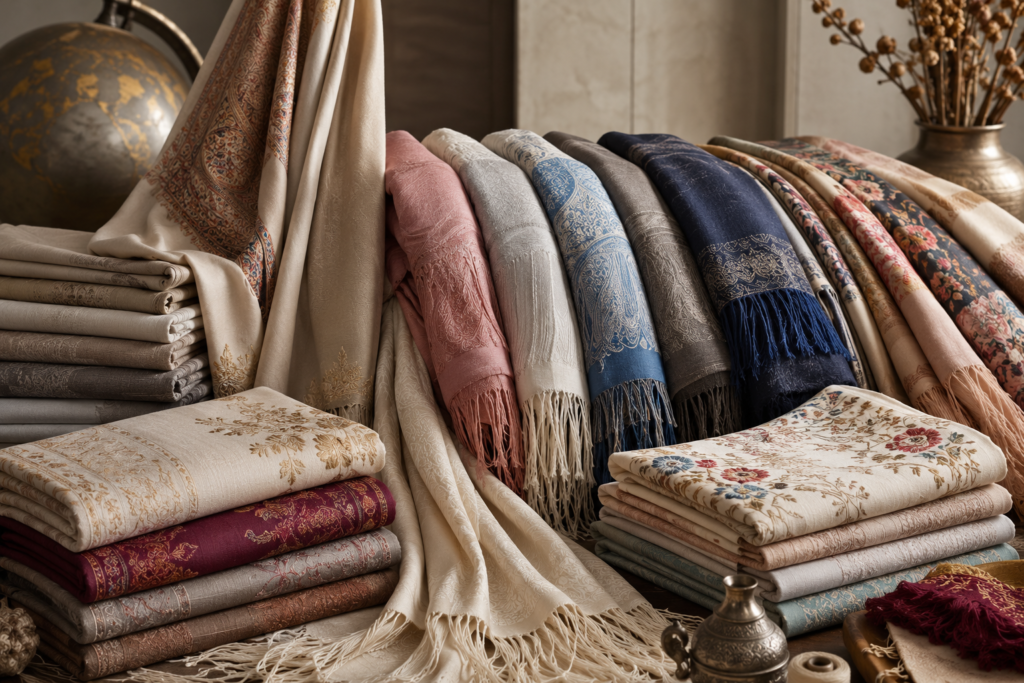
Premium Indian Shawls for Global Brands, Importers & Wholesale Buyers
Sourcing luxury Pashmina shawls for a boutique collection, cotton shawls for spring and summer retail, wool shawls for winter programs, or a full private label fashion range — the right export partner matters as much as the right product.
Scalane Global helps international buyers source premium-quality Indian shawls through a reliable export network built on quality, customization, and international trade support.
We work with importers, wholesalers, distributors, fashion retailers, department stores, boutique brands, buying houses, promotional companies, and private label businesses looking for dependable sourcing solutions from India.
Rather than simply supplying products, we simplify the sourcing process — from product selection and sampling to quality control, export documentation, packaging, and international shipping coordination.
Whether you need a seasonal fashion collection or a long-term sourcing partnership, our approach is built around consistency, transparent communication, and meeting buyer expectations across global markets.
Shawls Exporter from India – Quick Overview
Scalane Global supports international buyers with:
- Wholesale shawls for retail and distribution
- Private label and OEM manufacturing support
- Fashion, luxury, and promotional shawl collections
- Multiple material options including wool, cotton, silk, viscose, and blends
- Custom colors, prints, embroidery, labels, and packaging
- Export-ready documentation
- International shipping support
- Sampling and product development assistance
- Flexible sourcing solutions for growing and established brands
Looking for a sourcing partner instead of just another supplier? Our goal is to help buyers build dependable, long-term supply relationships with Indian manufacturers while reducing sourcing risk.
Why Source Shawls from India?
India has earned a strong reputation in the global textile industry by combining centuries of craftsmanship with modern manufacturing capability. From heritage weaving traditions in Kashmir to large-scale textile production clusters across Punjab, Uttar Pradesh, Rajasthan, and other regions, the country offers an extensive ecosystem for producing fashion accessories across every price segment.
For international buyers, sourcing from India means access to diverse materials, skilled craftsmanship, competitive manufacturing, and growing capabilities in customization and private label production.
Key advantages include:
Extensive Material Availability
India offers one of the world’s broadest selections of natural and blended fibers for shawl manufacturing, including:
- Wool
- Cashmere
- Pashmina
- Cotton
- Silk
- Viscose
- Modal
- Acrylic
- Linen
- Sustainable fiber blends
This range lets buyers develop collections for different seasons, customer segments, and retail price points.
Strong Manufacturing Ecosystem
Indian manufacturers produce both handcrafted and machine-made shawls using techniques such as:
- Hand weaving
- Power loom weaving
- Jacquard weaving
- Knitting
- Digital printing
- Screen printing
- Block printing
- Embroidery
- Fringe finishing
- Fabric finishing
This flexibility lets buyers source everything from affordable promotional shawls to premium designer collections.
Suitable for Different Market Segments
| Buyer Type | Typical Requirements |
|---|---|
| Importers | Reliable supply and export support |
| Wholesalers | Bulk production with consistent quality |
| Fashion Brands | Trend-driven collections |
| Boutique Stores | Premium craftsmanship and smaller collections |
| Department Stores | Large-scale seasonal sourcing |
| Private Label Companies | Custom branding and packaging |
| Promotional Businesses | Cost-effective customized products |
Growing Focus on Sustainable Production
Many Indian textile manufacturers are adopting environmentally responsible practices, including:
- Organic fibers
- AZO-free dyes
- Recycled materials
- Water-efficient processing
- Sustainable packaging options
- Improved traceability initiatives
Sustainability requirements vary by manufacturer and product category, so buyers should discuss specific certification or compliance needs during sourcing.
Understanding Shawls: A Quick Definition
A shawl is a versatile textile accessory that provides warmth, style, cultural expression, or functional layering. Depending on material, construction, and intended use, shawls suit:
- Winter fashion
- Luxury apparel
- Evening wear
- Travel
- Corporate gifting
- Hospitality
- Religious occasions
- Resort collections
- Fashion retail
- Promotional campaigns
Today’s international market spans both timeless handcrafted designs and contemporary fashion collections developed for global retailers.
Why Choose Scalane Global as Your Shawls Export Partner?
Selecting a supplier is about more than comparing prices. International buyers need confidence that their sourcing partner understands product quality, export logistics, communication, and long-term supply consistency. Scalane Global is a sourcing and export partner built to help buyers navigate all of this efficiently.
Buyer-Focused Product Selection
Every market has different expectations around materials, pricing, styles, and seasonal demand. We help buyers evaluate suitable product options based on:
- Target market
- Customer demographics
- Climate
- Retail positioning
- Budget
- Brand image
- Order quantity
- Packaging preferences
Support for Private Label Development
Many international buyers want products that reflect their own brand identity rather than generic wholesale merchandise. Depending on your project, we can support:
- Custom colors
- Fabric selection
- Prints
- Embroidery
- Woven labels
- Care labels
- Hang tags
- Brand packaging
- Retail-ready presentation
Dedicated pages on Private Label Shawls and OEM Shawl Manufacturing will cover this in more depth.
Export-Oriented Coordination
International sourcing involves far more than manufacturing. We coordinate:
- Product specifications
- Sample development
- Production communication
- Quality inspections
- Packaging requirements
- Export documentation
- Shipping coordination
This structured approach reduces misunderstandings during international transactions.
Focus on Long-Term Relationships
Rather than one-time transactions, we build partnerships based on:
- Clear communication
- Consistent product quality
- Timely updates
- Practical sourcing advice
- Professional documentation
- Reliable export support
Our goal is to become your dependable sourcing partner as your product range and business grow.
Buyer Tip
Before selecting a shawl supplier, look beyond product pricing. Consider:
- Manufacturing capabilities
- Material expertise
- Quality control process
- Sampling support
- Customization options
- Export experience
- Packaging capabilities
- Communication standards
- Documentation support
- Ability to scale production
These factors often matter more for long-term sourcing success than the initial quoted price.
Ready to Explore Shawl Sourcing from India?
Whether you’re building a new collection, expanding an existing line, or exploring private label opportunities, Scalane Global can help you evaluate the right sourcing options for your business. Discuss your project, request product information, or start with sample development before moving to bulk production.
Types of Shawls We Supply
International buyers source shawls for different climates, customer segments, fashion collections, and retail price points. Understanding each category helps you build a product range that fits your target market and brand positioning. The categories below see consistent demand across wholesale, retail, private label, and promotional sectors.
Fashion Shawls
Designed to complement contemporary apparel rather than provide heavy insulation, fashion shawls feature seasonal colors, modern prints, lightweight fabrics, and versatile styling. Common applications: fashion boutiques, department stores, e-commerce brands, lifestyle retailers, and resort collections. Popular materials: viscose, modal, cotton blends, lightweight wool, and silk blends.
Winter Shawls
Focused on warmth, softness, and comfort, winter shawls are widely purchased for autumn and winter collections across Europe, North America, and other colder regions. Typical materials: wool, merino wool, cashmere blends, acrylic blends, heavyweight viscose, and wool-silk blends.
Luxury Shawls
Luxury collections emphasize premium fibers, refined craftsmanship, intricate weaving, and sophisticated finishes. Commonly selected by luxury fashion brands, premium boutiques, designer labels, and high-end gifting companies. Materials may include pashmina, cashmere, fine merino wool, mulberry silk, and premium natural fiber blends.
Designer Shawls
Designer collections focus on exclusive aesthetics, innovative patterns, embroidery, textures, and fashion-forward color palettes — often using digital printing, jacquard weaving, hand embroidery, contemporary graphics, and limited-edition runs. (A dedicated Designer Shawls page will explore this category further.)
Printed Shawls
Printed shawls give buyers flexibility for seasonal collections and branded fashion programs. Popular techniques: digital printing, screen printing, block printing, reactive printing, and pigment printing. Suitable for fashion retailers, private label brands, and promotional collections.
Embroidered Shawls
Embroidery enhances perceived value and craftsmanship. Options may include machine embroidery, hand embroidery, aari work, sozni embroidery, decorative borders, and contemporary embellishments — popular for premium boutiques, festive ranges, luxury gifting, and special occasions.
Cotton & Summer Shawls
Lightweight cotton and breathable blends suit warmer climates and year-round layering. Applications: resort wear, spring collections, summer fashion, travel accessories, and casual lifestyle collections.
Corporate & Promotional Shawls
Organizations source customized shawls for corporate gifting, hospitality, conferences, universities, cultural events, tourism, and brand promotions. Private branding, custom packaging, and logo integration can often be added depending on project requirements.
Material Comparison Guide
Selecting the right fiber is one of the most important decisions when developing a shawl collection. Material shapes appearance, comfort, durability, price positioning, care requirements, and customer perception.
| Material | Best For | Warmth | Softness | Typical Market Position |
|---|---|---|---|---|
| Pashmina | Luxury collections | Excellent | Exceptional | Premium |
| Cashmere | Luxury fashion | Excellent | Excellent | Premium |
| Merino Wool | Winter collections | Excellent | Very High | Premium |
| Wool | Cold-weather products | High | High | Mid to Premium |
| Cotton | Summer collections | Low | Comfortable | Mid-range |
| Silk | Luxury fashion & evening wear | Moderate | Smooth | Premium |
| Viscose | Fashion collections | Moderate | Soft | Mid-range |
| Modal | Lightweight fashion | Moderate | Very Soft | Mid to Premium |
| Acrylic | Budget-friendly winter wear | High | Moderate | Economy |
| Blended Fibres | Versatile retail collections | Varies | Varies | Wide price range |
Buyer Insight: There’s no single “best” material — the ideal choice depends on your target market, climate, price point, and brand positioning.
How to Choose the Right Shawl Material
If your customers prioritize luxury, consider pashmina, cashmere, fine merino wool, or silk.
If your priority is affordability, popular options include acrylic blends, viscose, polyester blends, and cotton blends.
If sustainability is important, buyers may explore organic cotton, bamboo fibres, recycled fibres, eco-friendly viscose, and certified sustainable materials. Always confirm specific certifications and sustainable practices during supplier discussions.
If you sell year-round, many retailers mix materials seasonally — cotton for spring, lightweight viscose for summer, wool for autumn, and cashmere or merino for winter — to keep the product range relevant all year.
Understanding the Shawl Manufacturing Process
A well-managed manufacturing process drives product consistency, appearance, and customer satisfaction. Production methods vary by material and design, but a typical workflow includes these stages:
- Material Selection — choosing fibres based on product application, budget, target market, desired softness, warmth, durability, and sustainability requirements.
- Yarn Preparation — fibres are cleaned, processed, and spun into yarn. Yarn quality drives fabric strength, texture, drape, appearance, and long-term durability.
- Dyeing — yarn or fabric may be dyed using solid colors, reactive dyes, AZO-free dyes, Pantone color matching, or custom-developed shades. Color consistency matters most for private label programs, where brand identity depends on precise shade matching.
- Weaving or Knitting — hand weaving, power loom weaving, jacquard weaving, or knitting, each offering different texture, production capacity, design flexibility, and cost.
- Printing & Embellishment — digital printing, screen printing, block printing, embroidery, tassels, fringes, and decorative borders differentiate collections for specific retail segments.
- Finishing — washing, softening, heat setting, pressing, trimming, and fringe finishing improve final appearance and customer experience.
- Quality Inspection — checking dimensions, stitching, fabric quality, color consistency, oeko-tex print accuracy, embroidery quality, finishing, and packaging requirements before shipment.
What International Buyers Should Evaluate Before Ordering
Product appearance alone rarely tells the full story. Experienced buyers typically assess:
- Fabric Composition — verify the supplied fibre composition matches the agreed specification.
- GSM (Fabric Weight) — affects warmth, drape, thickness, customer expectations, and seasonal suitability. Choose GSM based on intended end use, not the highest number available.
- Color Fastness — quality shawls should hold their appearance under recommended care conditions; discuss testing expectations for washing, rubbing, perspiration, and light exposure.
- Stitching & Finishing — even stitching, clean edges, fringe quality, no loose threads, neat finishing.
- Print & Embroidery Accuracy — colors matching approved references, patterns correctly positioned, embroidery consistent across the batch.
- Packaging Consistency — export packaging that protects products in transit while meeting retail, wholesale, or e-commerce requirements.
Buyer Decision Checklist
- Does the supplier understand your target market?
- Can they offer suitable material recommendations?
- Is product customization available?
- How is quality controlled during production?
- Can they support export documentation?
- Are packaging options aligned with your retail needs?
- Is sampling available before bulk production?
- Can they communicate clearly throughout the project?
Working through these questions early helps set expectations and leads to a smoother sourcing experience.
Customization & Private Label Shawls
For many international buyers, the goal extends beyond purchasing ready-made products. Fashion brands, retailers, and e-commerce businesses often want collections that reflect their own identity, customer preferences, and market positioning.
Private label and OEM (Original Equipment Manufacturer) solutions let businesses build distinctive product lines while leveraging India’s manufacturing capabilities and textile expertise. At Scalane Global, we work closely with buyers to understand their commercial goals and coordinate suitable customization based on product category and production requirements.
Definition: Private Label Shawls are manufactured by a supplier but sold under the buyer’s own brand name, packaging, and identity.
Customization Options
Material Selection — choose materials that fit your brand positioning, climate, and target customer: wool, merino wool, cashmere, pashmina, cotton, silk, viscose, modal, acrylic, or sustainable fiber blends. Different materials support different pricing strategies, customer segments, and seasonal collections.
Custom Colors — color consistency matters for established fashion brands. Collections may be built around Pantone color references, seasonal trend palettes, brand-specific colors, or regional market preferences.
Custom Prints — fashion collections often need exclusive artwork through digital printing, screen printing, block printing, placement prints, all-over prints, or custom graphics. (Our upcoming Printed Shawls page will cover this in more detail.)
Embroidery & Decorative Finishes — for premium collections, explore machine embroidery, hand embroidery, decorative borders, tassels, fringe styles, and contemporary embellishments. (Our future Embroidered Shawls resource will go deeper on craftsmanship and technique.)
Private Branding — brand identity extends beyond the product itself. Private label programs may include woven labels, printed labels, care labels, hang tags, barcode stickers, QR codes, retail packaging, gift boxes, and brand inserts — creating a consistent customer experience from purchase through unboxing.
Typical Private Label Development Process
| Stage | Purpose |
|---|---|
| Requirement Discussion | Understand product goals, target market, and specifications |
| Material Selection | Recommend suitable fibers and construction |
| Design Development | Finalize colors, patterns, branding, and finishes |
| Sample Preparation | Review physical samples before production |
| Buyer Approval | Confirm all specifications |
| Production | Manufacture according to approved standards |
| Quality Inspection | Verify consistency before dispatch |
| Export & Shipping | Prepare documentation and coordinate shipment |
This structured approach minimizes revisions and supports smoother project execution.
Export Packaging Solutions
Packaging protects textile products during international transportation while supporting retail presentation and brand perception. The right packaging depends on shipping method, product category, retail positioning, storage conditions, sustainability objectives, and customer expectations.
Common Packaging Options: individual polybags, tissue paper wrapping, branded sleeves, gift boxes, cotton dust bags, master export cartons, barcode labeling, shipping marks, and carton identification labels. Retail-ready packaging can also be arranged for buyers who want to reduce post-import handling.
Protecting Products During International Shipping: International shipments can face humidity, temperature fluctuations, long transit times, and multiple handling stages. Appropriate export packaging reduces the risk of moisture damage, dust contamination, fabric creasing, product mix-ups, and carton damage. Packaging specifications should always align with your logistics and warehousing requirements.
Understanding the Export Process
International buyers often ask what happens after placing an order. Each project varies, but a typical export workflow follows these stages:
- Requirement Discussion — product specifications, materials, quantities, customization requirements, target market, packaging expectations, and delivery timelines.
- Sampling — buyers evaluate fabric, color, construction, finishing, and overall quality; feedback here helps finalize production specifications.
- Production Planning — schedules are coordinated based on material availability, manufacturing capacity, order volume, and delivery commitments.
- Quality Inspection — verifying quantity, dimensions, workmanship, packaging, labeling, and visual appearance before shipment; independent third-party inspections can also be arranged.
- Export Documentation — typically a Commercial Invoice, Packing List, Certificate of Origin (where applicable), Bill of Lading or Air Waybill, and any documents required by the destination country. Requirements vary by destination, Incoterms®, and local regulations.
- Shipping — sea freight, air freight, or courier services, depending on budget, lead time, and destination.
Industries We Serve
- Fashion & Apparel Brands — develop seasonal collections that align with changing consumer preferences.
- Wholesale Distributors — source consistent product ranges for regional or national distribution networks.
- Boutique Retailers — offer distinctive products that emphasize craftsmanship, materials, and design.
- Department Stores — build multi-category seasonal programs across varying price points and styles.
- E-commerce Businesses — develop retail-ready collections for online marketplaces and direct-to-consumer brands.
- Hospitality Industry — premium shawls can complement guest experiences, luxury amenities, and curated gift offerings in hotels, resorts, and wellness retreats.
- Corporate & Promotional Businesses — customized shawls for employee recognition, corporate gifting, conferences, brand promotions, and cultural events.
Global Export Capabilities
Every export market has its own expectations around product design, materials, pricing, compliance, labeling, and packaging. Rather than a one-size-fits-all approach, we work with buyers to understand the specific requirements of their destination market.
We support sourcing discussions for buyers across North America, Europe, the Middle East, Australia, Asia, and Africa. As our knowledge hub grows, we’ll also publish country-specific guides such as:
- Shawls Exporter to USA
- Shawls Exporter to UK
- Shawls Exporter to Germany
- Shawls Exporter to France
- Shawls Exporter to UAE
- Shawls Exporter to Canada
These resources will cover market preferences, import considerations, and sourcing opportunities in more detail.
International Buyer’s Sourcing Checklist
Product
- Does the material match your target market?
- Are dimensions and GSM suitable for your customers?
- Are colors and designs approved?
- Have you reviewed physical samples?
Quality
- Has the product been inspected?
- Are stitching and finishing consistent?
- Does the packaging meet your requirements?
Branding
- Are labels accurate?
- Is packaging aligned with your brand?
- Are care instructions included where required?
Export
- Have documentation requirements been confirmed?
- Is the preferred Incoterms® rule agreed upon?
- Have shipping timelines been discussed?
Supplier Relationship
- Is communication clear and timely?
- Can the supplier support repeat orders?
- Is there a structured approach to future product development?
Buyer Tip: A successful sourcing partnership is built on clear specifications, open communication, and realistic expectations. Investing time in planning before production helps reduce delays, revisions, and unnecessary costs later on.
Ready to Discuss Your Shawl Sourcing Requirements?
Whether you’re launching a new fashion collection, expanding an existing wholesale range, or exploring private label opportunities, choosing the right sourcing partner is an important business decision.
At Scalane Global, we take a consultative approach — understanding your product requirements, target market, quality expectations, and branding goals before recommending suitable sourcing solutions.
If you’d like to:
- Request a quotation for bulk shawls
- Explore private label manufacturing options
- Discuss custom designs, colors, or packaging
- Request product samples
- Learn more about export procedures
- Evaluate sourcing opportunities from India
our team will be happy to discuss your requirements and provide practical guidance tailored to your business.
Frequently Asked Questions (FAQs)
1. Why should I source shawls from India? India offers a combination of traditional craftsmanship, diverse textile materials, competitive manufacturing capabilities, and established export infrastructure. Buyers can source everything from premium handcrafted Pashmina shawls to large-volume fashion collections suitable for wholesale and private label businesses.
2. What types of shawls can Scalane Global help source? Wool shawls, cotton shawls, silk shawls, Pashmina shawls, cashmere shawls, viscose shawls, printed shawls, embroidered shawls, designer shawls, fashion shawls, lightweight shawls, and winter shawls. Dedicated pages for each category will provide more detailed product information.
3. Do you offer private label shawl manufacturing? Yes. We support private label sourcing projects that may include custom materials, brand labels, care labels, hang tags, custom colors, custom prints, embroidery, retail packaging, and gift packaging. Available options depend on the product and project requirements.
4. Can I request product samples before placing a bulk order? Yes. Sampling helps buyers evaluate fabric quality, workmanship, colors, finishes, and overall suitability before moving to larger production quantities.
5. Which materials are most suitable for premium collections? Luxury collections commonly feature pashmina, cashmere, fine merino wool, and mulberry silk. The most appropriate material depends on your target market, climate, retail positioning, and budget.
6. Which materials are suitable for cost-effective wholesale programs? Many buyers choose cotton, viscose, acrylic blends, polyester blends, or wool blends, which offer flexibility across price segments and seasonal collections.
7. Can you customize colors and designs? Yes. Depending on project requirements, customization can include Pantone color matching, exclusive prints, embroidery, brand labels, packaging, and seasonal collections.
8. What export documents are typically required? Generally a Commercial Invoice, Packing List, Certificate of Origin (where applicable), Bill of Lading or Air Waybill, and any additional documents required by destination-country regulations. Specific requirements vary by market and shipment.
9. Which countries do you supply? We support buyers from the USA, Canada, United Kingdom, Germany, France, Italy, UAE, Saudi Arabia, Australia, and other international markets.
10. How do I begin sourcing shawls from India? Discuss product requirements, select materials and designs, review samples, finalize specifications, confirm production, complete quality inspection, prepare export documentation, and ship the order. This structured process reduces sourcing risks and improves communication throughout the project.
Ready to Discuss Your Shawl Sourcing Requirements?
Every buyer has different objectives — some prioritize premium craftsmanship, others focus on competitive pricing, sustainable materials, private label development, or dependable long-term supply. At Scalane Global, we take a consultative approach to understanding your business before recommending suitable sourcing solutions.
Whether you’re launching a new fashion brand, expanding your wholesale product range, developing a private label collection, looking for a reliable export partner, or exploring sourcing opportunities from India — our team is ready to discuss your requirements and help you identify products that align with your market, customers, and commercial goals.
Contact us to:
- Request a quotation
- Discuss bulk sourcing
- Explore customization options
- Request product samples
- Learn about export procedures
- Start your next shawl sourcing project with confidence