
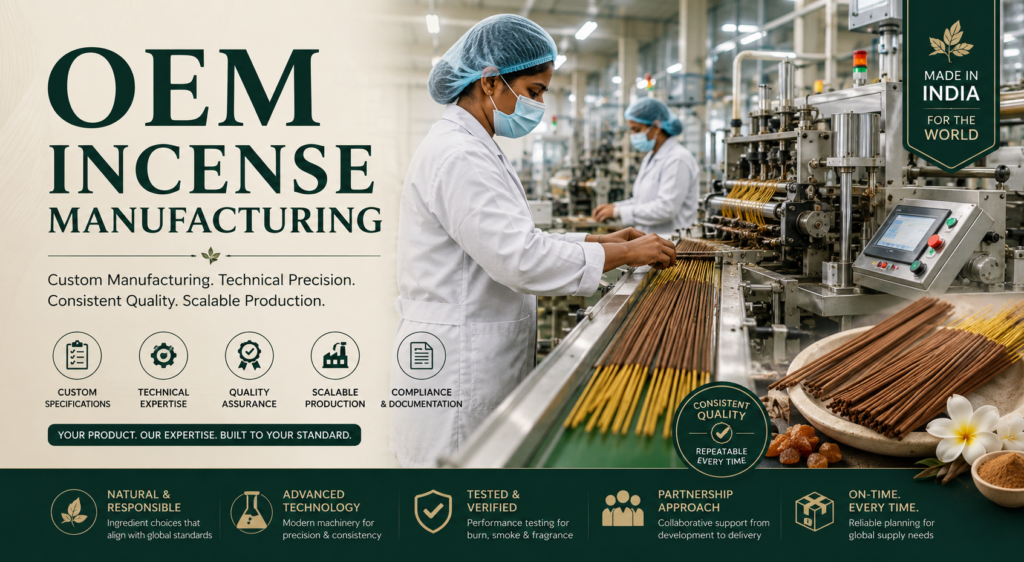
What Is OEM Incense Manufacturing?
OEM (Original Equipment Manufacturing) is a manufacturing model where products are produced to the buyer’s approved specifications, not from a catalog of standardized configurations.
Instead of choosing from pre-defined products, buyers set the technical requirements. Once approved, those requirements become the standard for every production run that follows.
Typical specifications include:
- Incense stick dimensions
- Bamboo core selection
- Coreless incense construction
- Fragrance intensity
- Burn duration
- Smoke characteristics
- Ingredient preferences
- Moisture parameters
- Packaging configuration
- Quality inspection criteria
Because these specifications become the reference point for every future production cycle, businesses can maintain product consistency batch after batch.
For companies looking for a long-term manufacturing partner, OEM manufacturing offers deeper technical control — without the capital investment of running your own production facility.
Why Businesses Choose OEM Manufacturing
Running an incense manufacturing facility takes specialized equipment, technical expertise, quality management systems, production planning, and continuous investment in infrastructure. That’s a lot to take on.
This is why many international companies choose OEM manufacturing instead: it lets them focus on product development, procurement strategy, distribution, and market expansion, while an experienced manufacturing partner handles production.
Benefits of OEM Manufacturing
| Benefit | Business Advantage |
|---|---|
| Technical Customization | Products manufactured to buyer-approved specifications |
| Production Expertise | Access to experienced manufacturing processes and technical knowledge |
| Scalable Manufacturing | Production planning that supports business growth |
| Process Consistency | Standardized manufacturing methods across production cycles |
| Reduced Capital Investment | No need to build or operate manufacturing facilities |
| Long-Term Manufacturing Support | Stable production for repeat orders and future expansion |
In short: OEM manufacturing lets businesses keep control over product specifications while relying on an established partner’s manufacturing capabilities and quality systems.
Industries We Support
OEM incense manufacturing suits organizations that need products built to defined technical specifications — not off-the-shelf commercial products. Our Private label manufacturing capabilities support a wide range of industries and business models.
International Consumer Brands Established brands that want consistent production while keeping full control over product specifications and quality requirements.
Home Fragrance Companies Businesses expanding their fragrance portfolio with incense products that match existing quality standards and product positioning.
Wellness & Lifestyle Brands Companies developing incense collections for wellness, meditation, yoga, relaxation, and holistic living.
Religious Product Companies Organizations that need incense manufactured to traditional performance characteristics, fragrance profiles, and quality standards.
Hospitality & Luxury Brands Businesses seeking customized incense products for premium guest experiences, hospitality environments, and luxury collections.
International Importers Organizations that need technically consistent manufacturing for long-term procurement programs and international distribution.
Manufacturing According to Approved Specifications
Every OEM project starts with understanding the buyer’s technical requirements. Rather than recommending standard products, we begin by reviewing product specifications, intended application, target market, and expected performance.
Typical manufacturing specifications include:
- Product dimensions
- Burn time requirements
- Fragrance profile
- Smoke level
- Raw material preferences
- Ingredient restrictions
- Appearance requirements
- Moisture content
- Packaging configuration
- Inspection standards
Documenting these specifications before production begins creates a repeatable manufacturing process — one that supports product consistency and long-term quality control.
Built for Long-Term Manufacturing Partnerships
OEM manufacturing is designed for businesses that want consistent production across multiple manufacturing cycles, not a one-time product purchase.
As demand grows, the manufacturing process, approved specifications, and quality standards stay the same. That foundation is what makes it possible to scale volume without losing consistency.
The result: businesses can expand their product portfolio with confidence, knowing manufacturing is based on documented specifications rather than changing production methods.
OEM Manufacturing Process
Successful OEM manufacturing starts with a clearly defined technical specification. Every project follows a structured manufacturing workflow designed to make sure the finished product consistently meets the buyer’s approved requirements.
Production isn’t a one-time activity. OEM manufacturing is about establishing documented manufacturing standards that can be repeated across future production cycles.
Typical OEM Manufacturing Workflow
| Stage | Objective |
|---|---|
| Technical Consultation | Review product specifications and manufacturing requirements |
| Product Feasibility | Evaluate manufacturing methods, raw materials, and production capability |
| Sample Development | Produce samples for technical evaluation and approval |
| Specification Approval | Finalize product standards before commercial production |
| Production Planning | Allocate manufacturing resources and schedule production |
| Commercial Manufacturing | Produce according to approved specifications |
| Quality Verification | Inspect products throughout manufacturing and before dispatch |
| Documentation & Dispatch | Prepare production records and shipment documentation |
A documented workflow like this improves consistency, reduces production risk, and supports long-term manufacturing programs.
Technical Customization Options
One of the biggest advantages of OEM manufacturing: products can be built to defined technical specifications instead of fixed product formats. Depending on project requirements, we can customize across multiple manufacturing parameters.
Common Technical Specifications
| Specification | Customization Options |
|---|---|
| Stick Length | Various commercial lengths according to buyer requirements |
| Stick Diameter | Customized for different burn characteristics |
| Burn Duration | Developed to meet target performance requirements |
| Smoke Profile | Standard or reduced-smoke formulations where feasible |
| Fragrance Intensity | Customized fragrance loading and performance |
| Bamboo Core | Different bamboo specifications based on product requirements |
| Core Construction | Bamboo-core or bamboo-less configurations |
| Raw Material Selection | Natural, herbal, charcoal-based, or other approved materials |
| Appearance | Surface finish, colour, and overall product presentation |
| Packaging Configuration | Product arrangement according to approved specifications |
Every specification is documented before production, so consistency carries through future manufacturing cycles.
Raw Material Selection
Finished incense quality depends directly on the quality and consistency of the raw materials used in manufacturing. OEM projects often call for specific raw material preferences based on product performance, fragrance compatibility, regulatory considerations, or Wholesale market expectations.
Depending on project requirements, manufacturing may involve:
- Bamboo sticks
- Bamboo-less formulations
- Natural plant-based ingredients
- Herbal ingredients
- Charcoal-based formulations
- Wood powders
- Natural binders
- Fragrance oils
- Essential oil blends
- Performance-enhancing ingredients where appropriate
Careful raw material selection is what makes consistent manufacturing possible — and what delivers the burn characteristics, fragrance performance, and product quality buyers expect.
Manufacturing Capabilities
Professional OEM manufacturing takes more than production equipment. It takes coordinated planning, controlled manufacturing processes, and the ability to deliver consistent quality across multiple production batches.
Manufacturing capability includes:
- Structured production planning
- Controlled manufacturing processes
- Batch production management
- Process monitoring
- Production scheduling
- Material planning
- Finished product inspection
- Repeat production capability
A systematic manufacturing approach is what lets businesses maintain product consistency while supporting future production growth.
Production Planning for Large Orders
International buyers often need manufacturing programs that go beyond a single purchase order. Effective production planning keeps manufacturing capacity, raw materials, and production schedules aligned with customer demand.
Planning typically considers:
- Production schedules
- Manufacturing lead times
- Material availability
- Packaging requirements
- Quality inspection stages
- Delivery schedules
- Future production forecasts
This structured planning process reduces disruptions and supports reliable production for ongoing OEM partnerships.
Scalable Manufacturing Solutions
As businesses grow, production requirements grow with them — in both complexity and volume. OEM manufacturing needs to support scalable production without compromising approved product specifications or manufacturing consistency.
Scalable manufacturing focuses on:
- Repeatable production processes
- Capacity planning
- Controlled batch production
- Standardized work procedures
- Documented manufacturing specifications
- Consistent quality verification
- Long-term production continuity
By establishing standardized manufacturing procedures early in the project, businesses can expand production while maintaining product performance and quality expectations.
Why Documentation Matters in OEM Projects
Accurate documentation is an essential part of professional OEM manufacturing. Every approved specification, production change, and quality requirement should be documented — creating a clear manufacturing reference for future production.
Typical manufacturing documentation includes:
- Approved product specifications
- Manufacturing records
- Batch identification
- Inspection reports
- Product testing records
- Quality approval documentation
- Shipment documentation
Organized documentation improves traceability, simplifies repeat production, and supports effective quality management throughout the manufacturing lifecycle.
Quality Management Throughout the Manufacturing Process
Consistent quality isn’t achieved through final inspection alone — it’s built into every stage of production, from raw material evaluation to finished product verification.
Professional OEM manufacturing follows documented procedures to make sure each production batch is manufactured to approved technical specifications. This systematic approach minimizes variation, improves repeatability, and supports long-term manufacturing partnerships.
Rather than relying on visual inspection alone, quality management combines process monitoring, product testing, documentation, and batch traceability throughout the manufacturing cycle.
Quality Control at Every Stage
Quality verification is built into multiple production stages, so potential variations are caught before products reach final inspection.
Typical Quality Control Process
| Manufacturing Stage | Quality Focus |
|---|---|
| Raw Material Inspection | Verify materials meet approved specifications before production begins |
| Production Monitoring | Monitor manufacturing processes to maintain consistency |
| In-Process Inspection | Evaluate product dimensions, coating quality, and overall appearance |
| Fragrance Verification | Check fragrance consistency against approved references |
| Performance Testing | Assess burn characteristics and product performance |
| Packaging Inspection | Verify packaging quality, labeling, and product presentation |
| Final Release Inspection | Confirm finished products meet approved specifications before dispatch |
This structured approach reduces variability and supports consistent manufacturing performance across repeat production cycles.
Batch Consistency for Repeat Production
One of the core goals of OEM manufacturing: reproducing the same product consistently, run after run. That takes careful control of manufacturing variables — raw materials, production methods, fragrance application, drying conditions, and inspection procedures.
Consistency is evaluated through:
- Product dimensions
- Fragrance profile
- Burn performance
- Smoke characteristics
- Appearance
- Packaging presentation
- Batch identification
- Production documentation
Documented production standards keep future manufacturing aligned with the originally approved specifications.
Product Testing & Performance Evaluation
OEM buyers need products that perform consistently under real-world conditions. Product evaluation may include technical assessments based on the approved specification and intended application.
Burn Performance Verifying products achieve the expected burn characteristics per the approved specification.
Fragrance Performance Evaluating fragrance consistency and overall sensory performance.
Physical Inspection Checking product appearance, coating uniformity, straightness, and overall workmanship.
Packaging Integrity Confirming packaging protects the product during storage, transportation, and distribution.
Batch Verification Comparing production batches against approved reference standards to maintain consistency.
Testing procedures vary depending on product type, technical requirements, and buyer expectations.
Manufacturing Technology & Production Methods
Different manufacturing methods suit different specifications, production volumes, and performance requirements. The production process should support the approved technical specification while keeping manufacturing efficient and product quality consistent.
Manufacturing Approaches
| Production Method | Typical Application |
|---|---|
| Hand-Rolled Production | Artisan and premium incense collections requiring traditional craftsmanship |
| Machine-Rolled Production | High-volume manufacturing with consistent dimensional control |
| Semi-Automated Production | Projects requiring a combination of production efficiency and manual finishing |
Choosing the right production method depends on the complexity of the product specification, desired output, and manufacturing objectives.
Compliance & Technical Documentation
International OEM buyers often need manufacturing documentation that supports product quality, regulatory compliance, and supply chain transparency.
Depending on the destination market and project requirements, documentation may include:
- Product Specification Sheets
- Batch Records
- Certificate of Analysis (where applicable)
- Safety Data Sheets (SDS/MSDS), where applicable
- IFRA Declarations for fragrance materials, where applicable
- Certificate of Origin (where applicable)
- Commercial Export Documentation (ICC)
- Product Traceability Records
Documentation requirements vary by product, fragrance composition, destination country (USA), and buyer specifications. Accurate technical documentation supports quality assurance and simplifies future production and regulatory reviews.
Common OEM Manufacturing Challenges
OEM projects often involve complex technical requirements — which is exactly why structured project management matters.
| Challenge | Manufacturing Consideration |
|---|---|
| Product Variation | Controlled through documented specifications and standardized production methods |
| Fragrance Inconsistency | Managed through approved formulations and controlled application processes |
| Raw Material Variation | Reduced through supplier qualification and material verification |
| Production Delays | Minimized through structured planning and production scheduling |
| Packaging Variations | Controlled through approved packaging specifications and inspections |
| Documentation Errors | Reduced through standardized documentation procedures |
| Repeat Production Accuracy | Supported by batch records, manufacturing documentation, and reference samples |
Manufacturing Insight: Successful OEM partnerships are built on repeatability. The goal isn’t one successful batch — it’s a documented manufacturing system that consistently delivers the same product across future production cycles.
Designed for Long-Term Manufacturing Programs
OEM manufacturing works best as an ongoing manufacturing partnership, not a series of individual orders. As demand grows, documented specifications, established production methods, and quality systems keep things consistent while supporting higher manufacturing volumes.
A structured manufacturing program delivers:
- Standardized production methods
- Controlled process management
- Repeatable product quality
- Improved traceability
- Better production planning
- Long-term manufacturing continuity
This approach lets businesses scale production with confidence — while protecting product quality and brand reputation.
Frequently Asked Questions
What is OEM incense manufacturing? OEM (Original Equipment Manufacturing) is a manufacturing model where incense products are produced to the buyer’s approved technical specifications — dimensions, burn performance, fragrance profile, raw materials, packaging configuration, and quality requirements.
How is OEM different from Private Label manufacturing? OEM manufacturing focuses on producing products to the buyer’s technical specifications and manufacturing requirements. Private label manufacturing focuses mainly on developing products under the buyer’s brand — branding, packaging, and product presentation. Businesses that need technical control over product specifications typically choose OEM manufacturing.
Who is OEM manufacturing suitable for? OEM manufacturing is commonly used by:
- International brands
- Home fragrance companies
- Wellness brands
- Religious product companies
- Hospitality groups
- Importers
- Retail organizations
- FMCG businesses
It’s particularly suited to organizations that need repeatable manufacturing based on documented specifications.
What information should I provide to start an OEM project? Detailed technical information helps streamline product development. Typically that includes:
- Product dimensions
- Burn time requirements
- Fragrance preferences
- Raw material requirements
- Smoke characteristics
- Packaging specifications
- Quality expectations
- Destination market
- Compliance requirements
Can product specifications be customized? Yes. OEM manufacturing is built around approved buyer specifications, so product characteristics can be customized according to project requirements and manufacturing feasibility.
Can fragrance formulations be developed according to specifications? Yes. Fragrance profiles can be developed or adjusted to approved project requirements while maintaining consistency across future production batches.
Can different incense formats be manufactured? Depending on project requirements, manufacturing may include:
- Incense sticks
- Masala incense
- Herbal incense
- Natural incense
- Charcoal incense
- Bamboo-less incense
- Dhoop sticks
- Incense cones
How is product consistency maintained? Through:
- Approved technical specifications
- Standardized manufacturing procedures
- Batch documentation
- Process monitoring
- Product testing
- Quality inspections
- Production records
What quality checks are typically performed?
- Raw material inspection
- Product dimensions
- Fragrance consistency
- Burn performance
- Packaging inspection
- Batch verification
- Final quality review
Can OEM manufacturing support repeat production? Yes. Documented specifications and production records help maintain consistency across future manufacturing cycles.
What documentation may be available? Depending on project requirements, documentation may include:
- Product Specification Sheets
- Batch Records
- Certificate of Analysis (where applicable)
- Safety Data Sheets (SDS/MSDS), where applicable
- IFRA Declarations (where applicable)
- Commercial export documentation
Can products be manufactured for different international markets? Yes. Manufacturing specifications and documentation can be aligned with project requirements and destination market expectations where applicable.
OEM Project Planning Checklist
Preparing detailed technical requirements before production improves communication and manufacturing efficiency. Before starting your OEM project, consider:
 Product dimensions Burn performance requirements Preferred fragrance profile Raw material preferences Smoke characteristics Packaging configuration Quality expectations Compliance requirements Destination market Forecast production volumes Future production planning
A structured project brief establishes clear manufacturing expectations and supports long-term production consistency.
Related Resources
Explore additional incense manufacturing and sourcing solutions:
- Incense Stick Exporter from India
- Wholesale Incense Sticks
- Private Label Incense Sticks
- Incense Stick Exporter to USA
- Masala Incense Sticks
- Natural Incense Sticks
- Herbal Incense Sticks
- Charcoal Incense Sticks
- Bamboo-less Incense Sticks
- Dhoop Sticks
- Incense Cones
- Export Documentation
Looking for an Experienced OEM Incense Manufacturing Partner?
Selecting an OEM manufacturing partner takes more than comparing production capabilities. It takes confidence in technical expertise, manufacturing consistency, quality management, and the ability to support repeat production over the long term.
At Scalane Global, we work with businesses that need incense products manufactured to clearly defined technical specifications. Our approach combines structured production planning, documented manufacturing processes, quality verification, and professional project coordination — all to support reliable OEM manufacturing programs.
Whether you’re developing a new product specification or expanding an existing manufacturing program, we’re committed to delivering consistent production aligned with your approved requirements.
Start Your OEM Manufacturing Project
Request a Technical Consultation Discuss your product specifications, manufacturing objectives, and technical requirements with our team.
Submit Your Product Specifications Share your technical drawings, product specifications, performance requirements, and manufacturing expectations for project evaluation.
Request Product Samples Review product quality, burn performance, fragrance characteristics, and overall manufacturing standards before commercial production.
Discuss Long-Term Manufacturing Programs Plan future production schedules, repeat manufacturing, and scalable production solutions that support your business growth.