
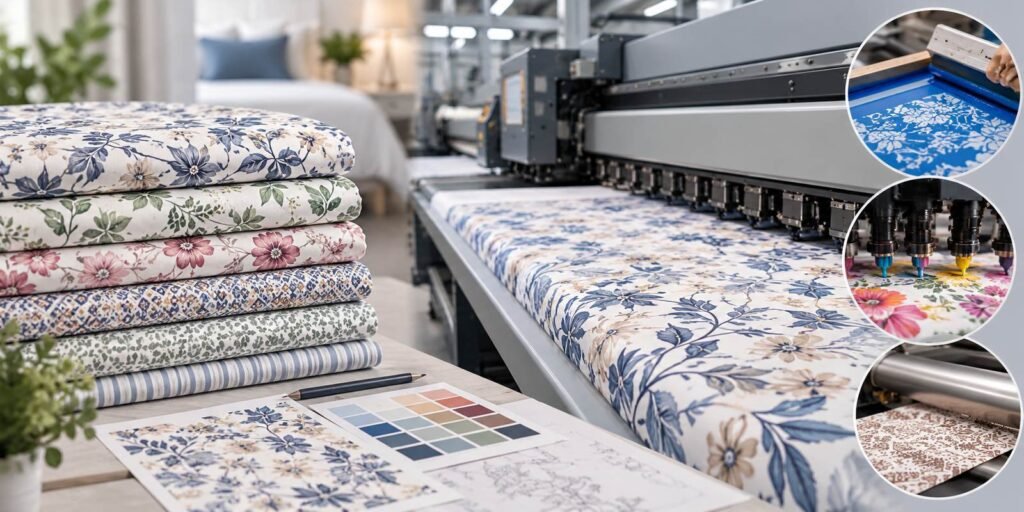
Bedsheet Printing Technology Guide
Bedsheet printing technology plays an important role in the appearance, durability and commercial positioning of printed bedding. Different printing methods can produce different results depending on the fabric, fiber composition, design complexity, order quantity, color requirements, printing area and target market.
Scalane Global is a bedsheet manufacturer and exporter from India supplying printed bedsheets for international importers, wholesalers, retailers, hospitality businesses, private-label brands and e-commerce companies.
This guide explains the main bedsheet printing technologies and the factors international buyers should consider when selecting a printing method.
Why Bedsheet Printing Technology Matters
Printing technology affects more than the appearance of a bedsheet.
It can influence:
- Print sharpness
- Color reproduction
- Pattern complexity
- Fabric handfeel
- Colorfastness
- Production quantity
- Setup requirements
- Production cost
- Lead time
- Design flexibility
- Repeatability between production batches
The most suitable printing process depends on the fabric and the buyer’s product requirements.
Main Types of Bedsheet Printing
Common printing technologies used for bedsheets and home textiles include:
- Reactive printing
- Pigment printing
- Digital textile printing
- Rotary screen printing
- Discharge printing
- Block printing
- Screen printing
- Transfer printing
Not every method is suitable for every fabric.
The fiber composition and fabric construction should be considered before selecting the printing technology.
Reactive Printing for Bedsheets
Reactive printing is commonly associated with cellulosic fibers such as cotton.
The process uses dyes that chemically bond with suitable fibers, allowing printed designs to become part of the fabric rather than simply forming a surface coating.
Potential advantages include:
- Strong color reproduction
- Good print penetration
- Suitable for cotton fabrics
- Detailed patterns
- Soft fabric handfeel when properly processed
- Good wash performance when correctly produced
Reactive printing can be considered for cotton bedsheets where color performance and fabric feel are important.
Reactive Printed Cotton Bedsheets
Cotton bedsheets can be developed with reactive printing for:
- Floral designs
- Geometric patterns
- Abstract designs
- Traditional patterns
- Children’s designs
- Seasonal collections
- Premium bedding
Buyers can provide their own artwork or request development based on a design concept.
Pigment Printing for Bedsheets
Pigment printing applies color to the fabric surface using pigments and a binder system.
It can be used across various textile constructions, subject to the fabric and process requirements.
Potential advantages include:
- Broad design possibilities
- Suitable for different fabric types
- Efficient for certain production programs
- Good color versatility
- Suitable for fashion and home textile designs
The final handfeel and durability depend heavily on the printing and curing process.
Digital Printing for Bedsheets
Digital textile printing uses inkjet technology to print designs directly onto textile material.
It can be particularly useful for:
- Complex artwork
- Photographic designs
- Small production runs
- Sampling
- Multiple designs
- Customized collections
Digital printing can reduce the need for conventional screen preparation, making it attractive for buyers developing smaller or highly customized collections.
Digital Printed Bedsheets
Digital printing allows buyers to develop detailed designs with many colors.
Possible applications include:
- Photographic patterns
- Watercolor designs
- Digital artwork
- Detailed florals
- Children’s graphics
- Custom illustrations
- Personalized collections
The final print quality depends on the printer, ink system, fabric preparation and production process.
Rotary Screen Printing for Bedsheets
Rotary screen printing is widely used for high-volume textile production.
The design is transferred through cylindrical screens onto the fabric.
Potential advantages include:
- Efficient large-scale production
- Consistent repeating designs
- High production speed
- Suitable for commercial quantities
- Multiple-color designs
However, screen preparation and setup can make rotary printing more Germany suitable for larger production quantities.
Screen Printing for Bedsheets
Screen printing uses prepared screens to apply colors to the fabric.
It can be suitable for selected designs and production requirements.
Factors to consider include:
- Number of colors
- Design complexity
- Print repeat
- Quantity
- Fabric
- Required coverage
The economics of screen printing generally improve as production quantity increases.
Discharge Printing for Bedsheets
Discharge printing removes or alters the existing dye in selected areas and can introduce another color depending on the process.
It can create distinctive effects on suitable dyed fabrics.
The technique requires careful control of:
- Fabric dye
- Discharge chemistry
- Printing conditions
- Color development
- Finishing
Its suitability should be evaluated through sampling before bulk production.
Block Printing for Bedsheets
Block printing is a traditional textile printing technique in which carved blocks are used to apply designs to fabric.
It can create a distinctive handcrafted appearance.
Block printing may be suitable for:
- Artisan collections
- Traditional designs
- Boutique bedding
- Small collections
- Heritage-inspired products
Because the process involves manual elements, slight variations can occur and may form part of the product’s intended character.
Transfer Printing for Bedsheets
Transfer printing involves transferring a printed design from another medium onto the fabric.
Its suitability depends on:
- Fabric composition
- Transfer material
- Ink system
- Required durability
- Product application
The process should be selected based on the intended bedsheet fabric and performance requirements.
Reactive vs Pigment Printing
| Factor | Reactive Printing | Pigment Printing |
|---|---|---|
| Common fabric application | Cellulosic fabrics | Various fabrics |
| Color penetration | Generally high | More surface-oriented |
| Handfeel | Can remain soft with proper processing | Depends on binder and curing |
| Design flexibility | High | High |
| Wash performance | Can be very good with proper processing | Depends on formulation and curing |
| Typical use | Cotton bedding | Cotton and other suitable fabrics |
The correct choice depends on the actual fabric and product requirements.
Digital vs Screen Printing
| Factor | Digital Printing | Screen Printing |
|---|---|---|
| Setup | Lower setup for artwork changes | Screen preparation required |
| Small quantities | Well suited | Less economical in some cases |
| Large quantities | Can be suitable | Highly suitable |
| Complex designs | Excellent | More limitations with many colors |
| Design changes | Easy | Requires new screens |
| Sampling | Very convenient | More setup required |
For small customized collections, digital printing can be attractive. For large repeat programs, conventional printing may provide better production economics.
Choosing the Right Printing Technology
The printing method should be selected after considering:
Fabric
First determine:
- Cotton
- Linen
- Polycotton
- Polyester
- Microfiber
- Other fiber blends
Quantity
Large orders and small trial orders may require different printing approaches.
Design
Consider:
- Number of colors
- Pattern complexity
- Photographic detail
- Repeat size
- Print coverage
Product Positioning
Printing requirements can differ between:
- Value bedding
- Mid-market bedding
- Premium bedding
- Luxury bedding
- Hotel bedding
- Children’s bedding
Target Market
Different markets may have different requirements for:
- Color
- Design
- Labeling
- Product safety
- Packaging
- Testing
Bedsheet Printing for Cotton
Cotton is commonly used for printed bedding.
Depending on the specific fabric, buyers can consider:
- Reactive printing
- Pigment printing
- Digital printing
- Screen printing
- Rotary printing
The final choice should be based on the fabric construction and required print performance.
Bedsheet Printing for Polycotton
Polycotton requires consideration of both cotton and polyester components.
The printing method should be selected based on the exact blend ratio and fabric construction.
Buyers should test:
- Color reproduction
- Wash performance
- Fabric handfeel
- Colorfastness
- Print appearance
before approving bulk production.
Bedsheet Printing for Linen
Linen and linen-blend fabrics require careful printing and finishing considerations.
Potential options can include:
- Digital printing
- Pigment printing
- Screen printing
- Other suitable textile printing systems
The final method depends on the linen construction, design and required appearance.
Bedsheet Printing for Microfiber
Microfiber bedsheets can be printed using processes suitable for synthetic fabrics.
Digital and other polyester-compatible printing systems may be considered depending on the fabric and desired result.
Buyers should evaluate:
- Color intensity
- Print sharpness
- Wash performance
- Fabric feel
- Colorfastness
All-Over Printed Bedsheets
All-over printing covers a large portion of the fabric surface.
It is suitable for designs such as:
- Floral
- Geometric
- Abstract
- Nature
- Traditional
- Children’s
- Seasonal
Buyers should specify the required print repeat and placement before production.
Placement Printed Bedsheets
Placement printing puts specific graphics or designs in predetermined areas.
Examples include:
- Center artwork
- Border design
- Corner motifs
- Pillowcase artwork
- Coordinated sheet and pillowcase designs
Placement accuracy becomes especially important when the design must align across multiple pieces.
Bedsheet Border Printing
Border printing can be used to create a distinctive appearance around the edge of a bedsheet.
Possible applications include:
- Decorative borders
- Contrast borders
- Floral borders
- Geometric borders
- Premium bedding designs
The buyer should provide the required border width and placement.
Bedsheet Digital Printing for Private Label Brands
Digital printing can be useful for private-label brands developing smaller collections.
Brands can test:
- Multiple designs
- Limited editions
- Seasonal collections
- Customized artwork
- New colorways
Successful designs can later be considered for larger-volume production using a different printing technology if commercially appropriate.
Bedsheet Printing for Amazon Sellers
Amazon and other e-commerce sellers may benefit from flexible printing options when testing new bedding designs.
Potential requirements include:
- Multiple patterns
- Small initial quantities
- Custom branding
- Coordinated pillowcases
- Retail packaging
- Barcode
- Product inserts
The appropriate printing method should be selected based on the expected order volume.
Custom Bedsheet Printing
Custom printing allows buyers to supply their own designs.
You can provide:
- Artwork
- Design files
- Color references
- Print repeat
- Placement instructions
- Pantone references
- Product photographs
- Existing samples
The manufacturer can then prepare a production sample for approval.
Bedsheet Print Sampling
A print strike-off or physical sample is recommended before bulk production.
The buyer should check:
- Color
- Print sharpness
- Design scale
- Repeat
- Placement
- Fabric handfeel
- Colorfastness
- Overall appearance
Digital images on a computer screen should not be treated as an exact substitute for physical color approval.
Bedsheet Printing Color Matching
Color matching is important for private-label and repeat production.
Buyers can provide:
- Pantone references
- Physical color standards
- Approved fabric samples
- Previous production samples
Lighting conditions can affect visual color evaluation, so an agreed color standard should be used.
Bedsheet Printing Quality Control
Quality control can cover:
- Print alignment
- Color consistency
- Print sharpness
- Pattern repeat
- Registration
- Missing areas
- Stains
- Smudging
- Fabric defects
For repeated production, approved samples and color standards can be used as references.
Bedsheet Printing Colorfastness
Depending on the product and destination market, buyers may request colorfastness testing for:
- Washing
- Rubbing
- Perspiration
- Light
The exact testing method and acceptance criteria should be agreed according to the intended market and product requirements.
For textile safety and testing information:
Bedsheet Printing Standards
Testing and compliance requirements can vary depending on:
- Destination country
- Fabric
- Fiber composition
- Intended use
- Retail channel
- Buyer requirements
Relevant textile testing standards should be established before bulk production.
For international standards information:
International Organization for Standardization (ISO)
Bedsheet Printing MOQ
Printing MOQ depends on the selected technology and product specification.
Factors can include:
- Printing method
- Fabric
- Number of colors
- Design
- Quantity
- Number of SKUs
- Fabric preparation
- Packaging
Digital printing may be more flexible for smaller design quantities, while rotary and conventional screen printing can become more commercially attractive at higher volumes.
Bedsheet Printing Cost
Printing cost depends on:
- Printing technology
- Fabric
- GSM
- Design complexity
- Number of colors
- Print coverage
- Quantity
- Number of designs
- Finishing
- Packaging
Therefore, there is no single printing cost that applies to every bedsheet.
Bedsheet Printing Manufacturer India
Scalane Global can discuss printed bedsheet manufacturing for international B2B buyers.
Potential services include:
- Fabric sourcing
- Printing development
- Custom designs
- Sampling
- Bulk manufacturing
- Quality control
- Packaging
- Private labeling
- Export
The printing technology is selected according to the product specification rather than using one method for every project.
Private Label Printed Bedsheets
Private-label buyers can develop printed bedding collections with customized:
- Designs
- Colors
- Sizes
- Labels
- Packaging
- Branding
Buyers can provide their own artwork or discuss design development.
OEM Printed Bedsheets
OEM customers can supply an existing printed bedsheet sample or technical specification.
The manufacturer can evaluate:
- Fabric
- Printing method
- Design
- Color
- Dimensions
- Construction
- Finishing
A production sample can then be developed for approval.
Printed Bedsheets for International Buyers
Scalane Global can discuss printed bedsheet manufacturing and export programs for buyers in:
- UK
- Europe
- USA
- Canada
- Australia
- UAE
- Saudi Arabia
- Qatar
- Kuwait
- Bahrain
- Oman
- Other international markets
Destination-specific labeling, packaging and testing requirements should be established before production.
How to Order Printed Bedsheets from India
A typical process is:
Inquiry → Fabric Selection → Artwork Review → Printing Method Selection → Quotation → Strike-Off/Sample → Approval → Bulk Production → Quality Inspection → Packaging → Export
For private-label products, branding and packaging approval are completed before bulk production.
Printed Bedsheet Buyer Inquiry
For an accurate quotation, send:
Fabric: Cotton / Polycotton / Linen / Microfiber / Other
Composition: Required percentage
GSM: Required GSM
Printing: Digital / Reactive / Pigment / Screen / Other
Design: Existing artwork / New design
Colors: Number or references
Print Coverage: All-over / Placement / Border
Size: Finished dimensions
Quantity: Pieces or sets
Packaging: Bulk / Retail / Private Label
Branding: Standard / Private Label / OEM
Destination: Country and port/city
Certification: Required certification, if applicable
If you do not have a complete specification, send a sample, photograph, fabric reference or artwork file.
Frequently Asked Questions
What is the best printing technology for bedsheets?
There is no single best method. The right technology depends on the fabric, design, quantity, color requirements and target price.
Which printing is best for cotton bedsheets?
Reactive printing is commonly considered for cotton because of its suitability for cellulosic fibers, while pigment and digital printing may also be suitable depending on the required result.
Is digital printing suitable for bedsheets?
Yes. Digital printing can be particularly useful for detailed designs, sampling, customized products and smaller production runs.
Is screen printing suitable for large orders?
It can be. Conventional or rotary screen printing can be commercially attractive for larger quantities with repeat designs.
Can you print our own designs?
Yes. Buyers can provide artwork, color references and print specifications for custom development.
Can you manufacture private-label printed bedsheets?
Yes. Private-label printed bedsheets can be developed with custom designs, branding and packaging.
Can you make printed fitted bedsheets?
Yes. Printed fitted bedsheets can be developed according to the required mattress dimensions, fabric and printing specification.
Can I receive a print sample before bulk production?
Yes. A physical sample or print approval process is recommended before bulk production.
What is the MOQ for printed bedsheets?
MOQ depends on the printing method, fabric, design, quantity, number of SKUs and customization.
Request a Printed Bedsheet Quote
If you are an importer, wholesaler, retailer, hotel supplier, distributor, private-label brand or e-commerce company, contact Scalane Global for printed bedsheet manufacturing and export from India.
Send us your:
- Fabric
- Composition
- GSM
- Artwork
- Printing requirement
- Size
- Quantity
- Packaging
- Branding requirements
- Destination market
You can also send a sample, artwork file, photograph or technical specification.
Request a Quote | Request Print Samples | Request Catalogue | Discuss Private Label | Discuss OEM | WhatsApp Us