
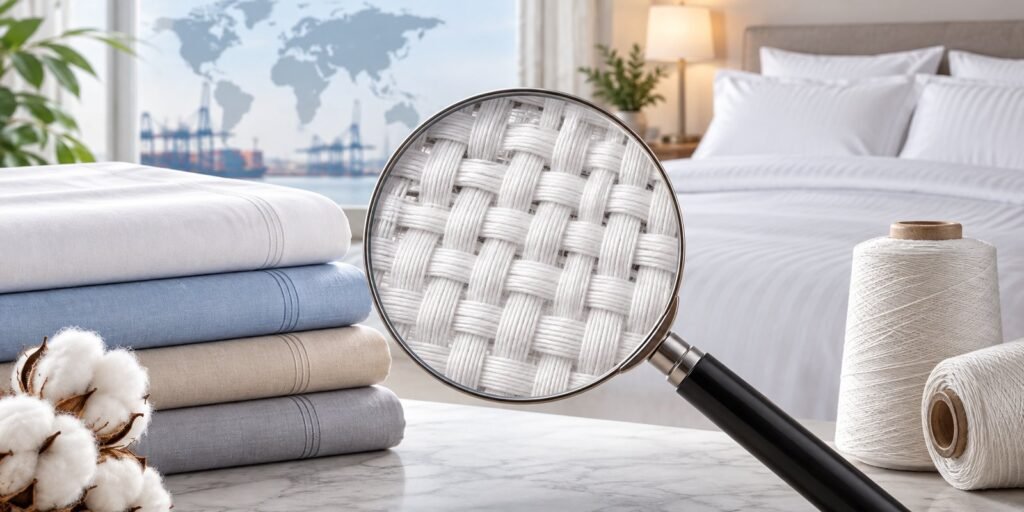
Thread count is one of the most widely used specifications when buying bedsheets, but it is also one of the most misunderstood.
For international buyers, importers, wholesalers, retailers, hotel procurement teams and private label brands, thread count should not be evaluated in isolation. The actual performance and value of a bedsheet also depend on fiber quality, yarn construction, weave, GSM, finishing, fabric density, workmanship and intended application.
Scalane Global is an Indian bedsheet manufacturer and exporter, supplying customized and bulk bedsheet programs for international buyers. We help buyers evaluate thread count alongside the other technical specifications that determine the suitability of a bedsheet for retail, hospitality, institutional and private label applications.
This guide explains what thread count means, how it is measured, common thread-count ranges, the relationship between thread count and fabric quality, and how buyers can specify the right construction for their market.
What Is Thread Count in Bedsheets?
Thread count, commonly abbreviated as TC, refers to the number of threads woven into one square inch of fabric.
It considers both:
- Warp threads — threads running lengthwise through the fabric
- Weft threads — threads running across the fabric
For example, a fabric containing approximately 150 warp threads and 150 weft threads per square inch would have a nominal thread count of 300.
However, thread count is fundamentally a fabric-density measurement, not a universal measurement of softness, durability or luxury.
This distinction is particularly important for buyers sourcing bedsheets in commercial quantities.
A 400 TC bedsheet is not automatically better than a 300 TC bedsheet, and a 600 TC product is not necessarily more comfortable or durable than a well-constructed 300 or 400 TC sheet.
Why Thread Count Matters to International Buyers
Thread count can influence several characteristics of woven bedsheet fabric, including:
- Fabric density
- Surface feel
- Opacity
- Drape
- Breathability
- Weight
- Appearance
- Perceived quality
- Production cost
But these characteristics are also affected by yarn count, fiber length, spinning quality, weave structure and finishing.
For this reason, professional buyers should specify thread count as one component of a broader technical specification.
A useful product specification might look like:
100% cotton + combed yarn + 300 TC + percale + specified GSM + approved finishing
rather than simply:
300 TC cotton bedsheet
The first specification gives a manufacturer much more information about the intended product.
Thread Count vs Fabric Quality
One of the most important concepts for a bedsheet buyer is that higher thread count does not automatically mean higher quality.
Consider two fabrics with the same nominal thread count.
One may use:
- Better-quality cotton
- Longer fibers
- Finer yarn
- Better spinning
- More consistent construction
- Higher-quality finishing
The other may use lower-quality yarn and rely primarily on increasing the number of threads.
The finished products may therefore feel and perform very differently.
What Should Be Evaluated Alongside Thread Count?
When developing a commercial bedsheet, consider:
Fiber
What type of cotton or other fiber is being used?
Yarn
Is the yarn carded, combed or otherwise processed for the intended quality level?
Weave
Is the fabric percale, sateen, plain weave or another construction?
GSM
How much does the finished fabric weigh?
Finishing
Has the fabric been mercerized, enzyme washed, softened or otherwise finished?
Performance
How does it perform after washing, drying and repeated use?
Workmanship
Are the cutting, stitching, hemming and finishing consistent?
This broader evaluation provides a much more reliable indication of product quality.
Common Thread Count Ranges for Bedsheets
There is no single internationally mandated classification system that makes a particular thread count automatically “premium” or “luxury.”
However, buyers commonly encounter products within broad ranges such as:
| Thread Count | Typical Positioning | Common Applications |
|---|---|---|
| 120–180 TC | Entry / value | Institutional, budget retail |
| 180–250 TC | Standard / mid-market | Retail, wholesale, hospitality |
| 250–300 TC | Mid to upper-mid | Retail, hotels, private label |
| 300–400 TC | Premium | Premium retail, upscale hospitality |
| 400–600 TC | Premium / luxury | Luxury retail, premium hotels |
| 600–800+ TC | High-count / specialty | Selected luxury programs |
These ranges are indicative rather than fixed industry definitions.
Actual suitability depends on fiber, yarn, weave, construction, finishing and the buyer’s target market.
120–180 TC Bedsheets
Lower thread-count bedsheets can provide an economical solution for buyers where cost, ease of laundering and volume are important.
They may be suitable for:
- Institutional programs
- Dormitories
- Hostels
- Budget accommodation
- Value-oriented retail
- Large-volume promotional programs
Lower TC does not necessarily mean poor quality.
A well-made fabric using suitable yarn and finishing can provide good performance even at a relatively modest thread count.
For institutional buyers, the more important question may be:
Does the product provide the required durability and laundering performance at the target cost?
180–250 TC Bedsheets
This range is widely relevant to mainstream commercial bedding.
Potential applications include:
- Wholesale bedding
- Mid-market retail
- Hotels
- Vacation rentals
- E-commerce bedding brands
- Private label collections
Depending on construction and finishing, these fabrics can offer a useful balance between:
- Comfort
- Durability
- Breathability
- Cost
- Wash performance
For buyers targeting mass-market or mid-market consumers, this range can often provide a practical commercial balance.
250–300 TC Bedsheets
Bedsheets around this range can move into a more premium retail positioning, particularly when combined with:
- Combed cotton
- Better-quality yarn
- Percale construction
- Sateen construction
- Mercerization
- Soft finishing
- Higher-quality stitching
This range can be relevant to private label brands and retailers looking to offer a noticeable quality upgrade without moving into extremely high-count constructions.
300–400 TC Bedsheets
A 300–400 TC construction is frequently associated with premium bedding.
Potential applications include:
- Premium retail
- Department stores
- Upscale hotels
- Private label brands
- Luxury-oriented e-commerce
- Premium bedding collections
At this level, fiber quality and weave become particularly important.
A 300 TC percale sheet and a 300 TC sateen sheet can provide distinctly different experiences despite having the same nominal thread count.
400–600 TC Bedsheets
Higher thread-count bedding is often positioned toward premium and luxury consumers.
Buyers may combine higher TC with:
- Long-staple cotton
- Combed yarn
- Sateen weave
- Mercerized finishing
- Premium packaging
- Embroidery or decorative details
However, the commercial value of increasing thread count should be evaluated carefully.
A buyer should ask:
Does the higher thread count improve the product characteristics that matter to my customers?
If not, increasing TC may simply increase cost without creating proportional consumer value.
600–800+ TC Bedsheets
Very high thread-count products occupy a specialized premium segment.
They may be marketed as luxury bedding, but buyers should investigate the underlying construction carefully.
Questions to ask include:
- What yarn is being used?
- Is the yarn single-ply or multi-ply?
- What is the actual fabric construction?
- What is the GSM?
- What is the weave?
- How does the fabric perform after washing?
- Is the claimed thread count measured consistently?
- What finishing process is used?
A high numerical TC should never replace proper technical evaluation.
Can Thread Count Be Too High?
Yes, depending on the construction and intended application.
Increasing fabric density can influence:
- Breathability
- Fabric weight
- Drying time
- Handfeel
- Drape
- Cost
For certain applications, an extremely high thread count may provide little practical benefit.
This is particularly important for:
- Hot climates
- Hospitality laundries
- Institutional use
- High-frequency washing
- Cost-sensitive retail
A buyer should therefore choose the appropriate thread count, rather than simply the highest available thread count.
Single-Ply vs Multi-Ply Yarn
Thread-count claims can become difficult to compare when manufacturers use different yarn constructions.
Single-Ply Yarn
A single-ply yarn consists of one yarn strand.
A fabric made with fine, high-quality single-ply yarn can provide a smooth and comfortable fabric without requiring an extremely high nominal thread count.
Multi-Ply Yarn
Multi-ply yarns are formed by combining yarn strands.
Some high-thread-count products use multi-ply yarn constructions to increase the apparent thread count.
This is one reason buyers should not compare products solely on the headline TC number.
A Better Specification
Instead of requesting:
“Highest possible thread count”
a professional buyer can specify:
Fiber + yarn specification + thread count + weave + GSM + finishing + performance requirements
This gives the manufacturing team a much clearer target.
Thread Count and Weave
Thread count interacts strongly with weave.
Percale
Percale is generally associated with a crisp, cool and breathable handfeel.
It is commonly considered for:
- Hotels
- Warm climates
- Premium retail
- Everyday bedding
Sateen
Sateen generally provides a smoother, softer and more lustrous surface.
It is commonly selected for:
- Luxury bedding
- Premium retail
- Upscale hospitality
- Decorative collections
Two bedsheets with identical thread counts can therefore feel very different because of their weave construction.
Thread Count and GSM
Thread count and GSM measure different things.
Thread Count: Indicates the number of warp and weft threads per square inch.
GSM: Indicates fabric weight in grams per square metre.
A high TC does not automatically mean high GSM.
Similarly, a heavier fabric does not automatically have a higher TC.
For product development, buyers should consider both parameters together.
For example:
300 TC + 120 GSM
and
300 TC + 150 GSM
represent different fabric specifications even though the thread count is identical.
Thread Count and Cotton Quality
Cotton quality plays an important role in how a high-thread-count fabric performs.
Longer and more consistent fibers can support finer, stronger yarns.
This can contribute to:
- Smoother fabric
- Better yarn strength
- Reduced surface hairiness
- Better appearance
- More consistent construction
For premium bedding, buyers may therefore evaluate:
- Cotton type
- Fiber length
- Yarn preparation
- Combing
- Yarn count
- Weave
- Thread count
- Finishing
rather than relying solely on TC.
Combed Cotton and Thread Count
Combing removes many shorter fibers and impurities from cotton during yarn preparation.
Combed cotton can produce yarn with a smoother and more consistent structure.
This makes it particularly relevant for:
- Premium cotton bedsheets
- Higher thread-count fabrics
- Private label bedding
- Hotel linen
- Luxury collections
However, combed cotton itself does not guarantee a particular quality level.
The final product still depends on the complete fabric and manufacturing specification.
Thread Count for Hotel Bedsheets
Hotels have different priorities from luxury retail consumers.
A hotel may need bedsheets that can withstand:
- Frequent industrial washing
- Repeated drying
- Regular ironing
- High occupancy
- Commercial handling
- Frequent replacement cycles
Therefore, a hotel buyer may choose a moderate thread count combined with a durable construction rather than selecting the highest possible TC.
Common commercial specifications may fall within approximately 180–300 TC, while premium properties may specify higher counts depending on their positioning and operational requirements.
The final specification should be based on the hotel’s laundering system, room category, procurement budget and desired guest experience.
Thread Count for Hospital and Institutional Bedsheets
Institutional buyers often prioritize:
- Durability
- Easy care
- Dimensional stability
- Frequent laundering performance
- Cost per use
- Consistent supply
A moderate thread count may therefore be more practical than a luxury construction.
For these applications, buyers should consider thread count together with:
- Fiber composition
- GSM
- Seam strength
- Shrinkage
- Colorfastness
- Laundering requirements
- Finishing
Thread Count for Private Label Bedsheets
Private label brands should select thread count according to their target customer and retail price position.
For example:
Value Collection
Approximately 120–200 TC may be considered depending on the fabric and market.
Core Collection
Approximately 200–300 TC can provide a commercially attractive balance.
Premium Collection
Approximately 300–500 TC may be appropriate depending on fiber and weave.
Luxury Collection
Higher-count constructions may be considered alongside premium cotton, specialized weaving and finishing.
These are not rigid categories. A private label brand should develop its product around its target consumer rather than choosing a TC number simply because it sounds premium.
How International Buyers Should Specify Thread Count
When requesting a quotation from an Indian bedsheet manufacturer, avoid sending only:
“Please quote 500 TC bedsheets.”
Instead, provide as much of the following as possible:
Fiber: 100% cotton
Yarn: Combed
Thread Count: 300 TC
Weave: Percale
GSM: 120–130 GSM
Finish: Soft / approved finish
Size: Queen
Color: White
Application: Hotel
Quantity: Bulk order
Packaging: As specified
This creates a much more useful technical basis for quotation and sampling.
How to Compare Two Bedsheet Samples
If you are evaluating suppliers, compare samples systematically.
Step 1 — Check Fiber
Confirm the declared composition.
Step 2 — Check Construction
Review weave, yarn and fabric structure.
Step 3 — Evaluate Handfeel
Assess softness, smoothness, crispness and drape.
Step 4 — Measure Dimensions
Check finished size and tolerances.
Step 5 — Check GSM
Compare fabric weight against the approved specification.
Step 6 — Wash the Sample
Observe:
- Shrinkage
- Color change
- Surface appearance
- Softness
- Pilling
- Shape retention
Step 7 — Inspect Stitching
Check:
- Hems
- Seams
- Thread trimming
- Corner construction
- Label placement
Step 8 — Compare After Washing
The post-wash condition can reveal more about a bedsheet than its appearance when brand new.
Thread Count Should Be Part of a Complete Technical Specification
For professional sourcing, the ideal bedsheet specification is multidimensional.
Fiber
↓
Yarn
↓
Thread Count
↓
Weave
↓
GSM
↓
Finishing
↓
Dimensions
↓
Performance Requirements
↓
Packaging
This approach enables buyers and manufacturers to discuss the product using measurable parameters instead of marketing claims alone.
Sourcing Thread-Count Bedsheets from India
India has a large cotton and textile manufacturing ecosystem capable of producing bedsheets across different price and quality segments.
Indian bedsheet manufacturers and exporters can develop products ranging from basic commercial constructions to premium cotton bedding, depending on the required fabric, production capability, finishing and order volume.
Scalane Global supports international buyers seeking bulk bedsheets manufactured in India, including customized thread-count specifications for:
- Importers
- Wholesalers
- Retailers
- Hotels
- Hospitality groups
- Private label brands
- E-commerce brands
- Institutional buyers
The specification can be developed around the USA buyer’s target market rather than forcing every customer into a standard product.
Request a Custom Thread Count Bedsheet Quote
If you already know the required thread count, send us the specification.
If you are unsure whether 200 TC, 300 TC, 400 TC or 500 TC is appropriate for your market, share:
- Target country
- Target customer
- Intended application
- Approximate retail price
- Quantity
- Preferred fabric
- Existing reference product
We can then discuss the broader product specification required for sourcing.
Request a Sample
Send your preferred thread count, fabric and size requirements for sample development.
Request a Bulk Quote
Share your estimated quantity and destination for a commercial quotation.
Discuss Private Label / OEM
Tell us about your brand, product concept, packaging and technical requirements.
Scalane Global
Indian Bedsheet Manufacturer & Exporter
Connecting the World with Premium Indian Products
How Thread Count Affects Bedsheet Quality
Thread count is one of the most commonly discussed specifications when purchasing bedsheets, but it should never be evaluated in isolation. The actual performance and value of a bedsheet depend on several factors, including fiber quality, yarn construction, weave, finishing, fabric weight, stitching and intended application.
For international buyers, comparing only the advertised thread count can lead to misleading conclusions. A well-made 200–300 thread count cotton bedsheet can offer better breathability, durability and comfort than a poorly constructed sheet marketed with an extremely high thread count.
At Scalane Global, we manufacture and export bedsheets from India according to buyer-defined specifications. Thread count can be developed alongside fabric composition, yarn selection, GSM, weave, wto finishing, dimensions and packaging requirements.
What Is Thread Count?
Thread count, commonly abbreviated as TC, refers to the number of warp and weft threads present within one square inch of woven fabric.
For example, if a fabric contains approximately:
- 120 warp threads
- 80 weft threads
within one square inch, the nominal thread count would be approximately 200 TC.
However, thread count alone does not tell a buyer:
- What type of cotton was used
- Whether the yarn is combed or carded
- How fine the yarn is
- What weave construction was used
- How the fabric was finished
- How the fabric performs after washing
- How durable the sheet will be
This is why professional sourcing specifications should include fiber composition + yarn specification + weave + thread count + GSM + finishing + testing requirements rather than relying on TC alone.
Common Thread Count Ranges for Bedsheets
There is no universal thread count that is ideal for every market or application.
Different buyer segments require different balances between softness, durability, breathability, appearance, price and laundering performance.
| Thread Count | Typical Positioning | Common Applications |
|---|---|---|
| 120–180 TC | Economy / Institutional | Budget retail, hostels, institutional use |
| 180–220 TC | Entry to Mid-Market | Retail, wholesale, hospitality |
| 200–300 TC | Mid-Market | Retail, hotels, private label |
| 300–400 TC | Premium | Premium retail, upscale hospitality |
| 400–600 TC | Luxury | Luxury retail and premium hospitality |
| 600+ TC | Ultra-Premium | Selected luxury collections |
These ranges are indicative rather than absolute. The appropriate specification depends on the fabric construction and the buyer’s target market.
200 TC vs 300 TC Bedsheets
One of the most common sourcing decisions is whether to select a 200 TC or 300 TC bedsheet.
200 TC Bedsheets
A 200 TC bedsheet can provide an attractive balance between:
- Cost
- Breathability
- Durability
- Comfort
- Wash performance
- Retail price
This specification can be suitable for:
- Wholesale programs
- Mid-market retailers
- Hotels
- Institutional buyers
- Large-volume private label programs
300 TC Bedsheets
Moving toward 300 TC can provide a denser and more refined fabric construction when supported by suitable yarn quality and finishing.
It can be appropriate for:
- Premium retail
- Private label brands
- Department stores
- Upscale hotels
- Premium bedding collections
However, 300 TC does not automatically mean better quality than 200 TC. Fiber quality, yarn construction and finishing remain important.
400 TC, 500 TC and 600 TC Bedsheets
Higher thread count bedsheets are generally positioned toward premium and luxury markets.
A 400–600 TC specification may be attractive for buyers seeking:
- A smoother handfeel
- A denser fabric appearance
- Premium product positioning
- Luxury packaging
- Upscale hospitality collections
But buyers should carefully examine how the stated thread count has been achieved.
Very high advertised counts can sometimes involve multi-ply yarns or counting practices that make direct comparisons difficult.
Our recommendation for buyers
Instead of asking only:
“What is your highest thread count?”
ask for a complete fabric specification covering:
Fiber → Yarn → Construction → Weave → Thread Count → GSM → Finish → Testing
This produces a much more meaningful comparison between suppliers.
Thread Count and Weave
Thread count should always be evaluated together with weave.
Percale Bedsheets
Percale is based on a plain-weave construction and is generally associated with a:
- Crisp handfeel
- Matte appearance
- Breathable construction
- Cool sleeping sensation
Percale is particularly attractive for:
- Hotels
- Warm climates
- Premium everyday bedding
- Cotton bedding collections
A 200–300 TC percale sheet can therefore offer a very different feel from a 300 TC sateen sheet.
Sateen Bedsheets
Sateen uses a construction with longer surface floats, producing a:
- Smooth feel
- Subtle sheen
- Drapier appearance
- Softer initial handfeel
Sateen is commonly used in:
- Luxury bedding
- Premium retail
- High-end hospitality
- Private label collections
Therefore, 300 TC percale and 300 TC sateen should not be treated as identical products.
Thread Count and GSM
Thread count and GSM measure different characteristics.
Thread count relates to the number of warp and weft threads within a defined area.
GSM refers to the weight of the fabric in grams per square metre.
A bedsheet with a higher thread count does not necessarily have proportionally higher GSM.
For B2B sourcing, buyers should specify both where appropriate.
For example:
100% cotton / combed yarn / 300 TC / sateen / approximately 120–140 GSM
provides significantly more useful information than simply:
300 TC cotton bedsheet.
Actual GSM should be confirmed against the agreed technical specification and manufacturing construction.
Does Higher Thread Count Mean Better Quality?
Not necessarily.
This is one of the most important points for international bedsheet buyers.
A high thread count can contribute to a denser and smoother fabric, but quality depends on a combination of factors.
Key quality factors include:
- Fiber quality
- Staple length
- Yarn quality
- Combing
- Yarn count
- Weave construction
- Thread density
- GSM
- Dyeing and printing
- Finishing
- Shrinkage control
- Colorfastness
- Stitching
- Quality inspection
For this reason, an experienced international buyer should evaluate the complete fabric specification rather than using thread count as the sole quality indicator.
Thread Count for Hotel Bedsheets
Hotel buyers generally need to balance guest comfort with:
- Frequent washing
- Commercial laundering
- Durability
- Drying time
- Replacement costs
- Operating budgets
- Dimensional stability
For many hotel programs, moderate thread counts such as approximately 180–300 TC can provide a practical balance.
Premium hotels may specify higher thread counts, particularly for suites and luxury room categories.
However, hotel procurement should focus on performance after repeated laundering, not simply the highest TC available.
Important specifications may include:
- Fiber composition
- TC
- GSM
- Weave
- Shrinkage
- Colorfastness
- Tensile strength
- Seam strength
- Pilling resistance
- Wash durability
Thread Count for Private Label Bedsheets
Private label brands often need several quality levels rather than a single thread count.
A brand may develop a product ladder such as:
Essential Collection
120–200 TC
Designed for competitive pricing and high-volume retail.
Comfort Collection
200–300 TC
A balanced option for mainstream retail.
Premium Collection
300–400 TC
Designed for higher-value positioning.
Luxury Collection
400–600+ TC
Developed for premium and luxury customers.
The exact specifications should be developed according to the brand’s target retail price, customer expectations and market positioning.
Scalane Global can coordinate custom bedsheet specifications, branding, packaging and export requirements for international private label buyers.
Thread Count for Wholesale Bedsheets
Wholesale buyers typically need to balance quality and landed cost.
A 180–300 TC range can be commercially attractive for many mainstream wholesale programs, depending on:
- Cotton quality
- Fabric construction
- Size
- Packaging
- Order quantity
- Destination market
- Printing requirements
For larger programs, buyers can also create multiple TC levels within the same assortment.
This allows distributors and retailers to serve different price points without completely changing their sourcing strategy.
Thread Count for Luxury Bedsheets
Luxury buyers generally look beyond thread count.
A premium specification may combine:
- Long-staple cotton
- Fine yarn
- Combed construction
- Higher thread density
- Premium percale or sateen weave
- Mercerization or specialized finishing
- Precise stitching
- Premium packaging
Egyptian cotton and other long-staple cotton specifications may also be considered depending on sourcing requirements and verified fiber claims.
For luxury products, the overall fabric engineering and finishing quality should support the premium positioning.
Thread Count and Cotton Type
Thread count should also be considered alongside cotton type.
Regular Cotton
Suitable for a broad range of commercial bedsheet programs.
Combed Cotton
Combing removes shorter fibers and impurities, helping produce smoother and more consistent yarn.
Long-Staple Cotton
Longer fibers can support finer, stronger yarns and premium fabric constructions.
Organic Cotton
Organic cotton is increasingly relevant to brands with sustainability-focused product ranges. Buyers should verify the applicable certification and supply-chain requirements before making organic claims.
Egyptian Cotton
Egyptian cotton is positioned in the premium segment, but buyers should ensure that any Egyptian cotton claim is properly substantiated and documented.
How Buyers Should Specify Thread Count
For an international quotation, we recommend providing a technical requirement such as:
Product: Cotton Flat Bedsheet
Fiber: 100% Cotton
Yarn: Combed Cotton
Thread Count: 300 TC
Weave: Percale
GSM: Buyer specified / agreed range
Finish: Soft finish
Size: Buyer specification
Color: Pantone / approved lab dip
Branding: Private label
Packaging: Retail packaging
Inspection: Buyer-approved QC protocol
This allows the supplier to quote a product accurately instead of giving a misleading price based only on thread count.
What International Buyers Should Ask a Bedsheet Manufacturer
Before placing a bulk order, ask the supplier:
Fabric
- What is the fiber composition?
- Is the cotton combed or carded?
- What yarn specification is being used?
- What is the weave?
- What is the actual thread count?
- What is the GSM?
Performance
- What is the expected shrinkage?
- What colorfastness standards are available?
- How does the fabric perform after washing?
- Is pilling testing available?
- Can testing reports be provided?
Production
- What sizes can be manufactured?
- Can the fabric be custom developed?
- Can colors be matched?
- What printing and dyeing options are available?
- Can the product be manufactured under private label?
Export
- What packaging options are available?
- Can EAN/UPC barcodes be applied?
- Can woven and printed labels be supplied?
- What export carton configurations are available?
- What are the MOQ and lead time?
A professional supplier should be able to discuss these specifications clearly before production begins.
Get a Custom Bedsheet Specification & Quote
There is no single “best” thread count for every buyer.
The right specification depends on your market, retail price, product positioning, climate, laundering requirements, target customer and order volume.
If you are sourcing bedsheets from India for wholesale, retail, hospitality or a private label brand, send us your requirements.
Scalane Global manufactures and exports bedsheets from India and can coordinate specifications covering fabric, thread count, GSM, weave, sizes, printing, finishing, branding and export packaging.
Request a quotation
Share:
- Product type
- Fabric preference
- Thread count
- GSM requirement
- Sizes
- Quantity
- Target market
- Branding requirements
- Packaging requirements
Our team can then help develop a specification suitable for your market and procurement requirements.
Looking for a different specification?
We can also discuss samples and custom product development before bulk production.