
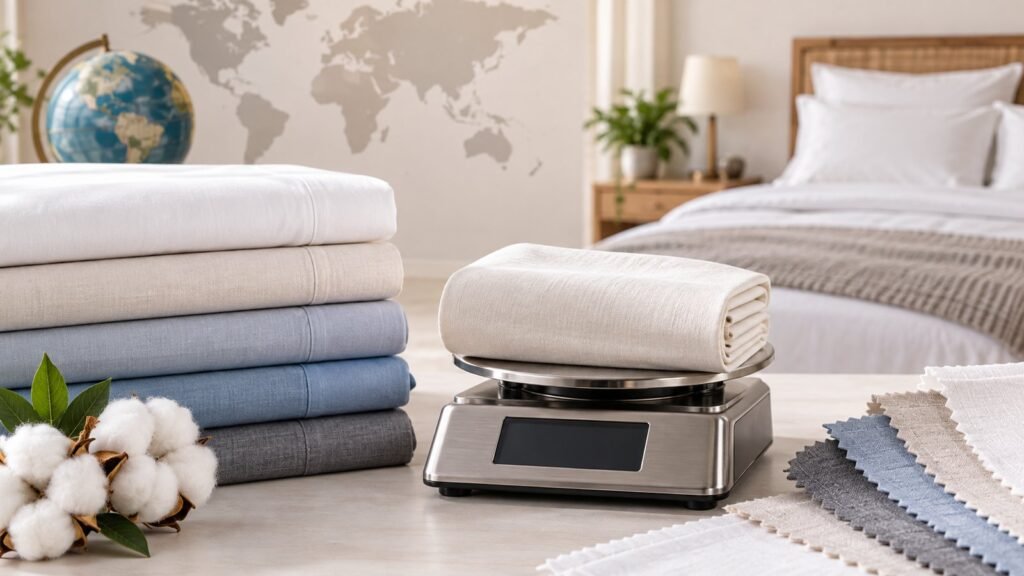
GSM is an important technical specification when sourcing bedsheets, especially for international wholesalers, retailers, hotel procurement companies, private label brands and institutional buyers.
GSM stands for grams per square metre and indicates the weight of a fabric over a defined area. In bedsheets, GSM can influence the fabric’s handfeel, drape, opacity, durability, breathability, drying characteristics and overall product positioning.
However, higher GSM does not automatically mean better bedsheet quality.
A 100% cotton bedsheet with lower GSM may be intentionally designed for a cool, lightweight feel, while a higher-GSM bedsheet may be developed for greater substance, warmth or premium positioning. The correct GSM depends on the fiber, yarn, weave, thread count, finishing, climate, application and target market.
Scalane Global manufactures and exports bedsheets from India for international buyers seeking standard or customized specifications, including different GSM requirements, fabric compositions, sizes, weaves, finishes, printing, branding and export packaging.
What Is GSM in Bedsheets?
GSM means Grams per Square Metre.
It represents the weight of one square metre of fabric.
For example:
- 100 GSM = approximately 100 grams per square metre
- 120 GSM = approximately 120 grams per square metre
- 140 GSM = approximately 140 grams per square metre
- 160 GSM = approximately 160 grams per square metre
GSM is a fabric-weight measurement, not a direct measurement of quality.
Two bedsheets can have the same GSM while having significantly different:
- Fiber compositions
- Yarn qualities
- Thread counts
- Weaves
- Finishes
- Handfeel
- Durability
- Appearance
This is why professional B2B buyers should evaluate GSM together with the complete technical specification.
Why GSM Matters When Buying Bedsheets
For international buyers, GSM can affect both the consumer experience and commercial performance of a bedsheet.
A fabric’s weight can influence:
Comfort
Lower-weight fabrics can feel lighter and more breathable, while heavier constructions may provide a more substantial feel.
Drape
GSM contributes to how fabric hangs over a mattress and how it behaves after washing.
Durability
Fabric weight can contribute to durability, although fiber quality, yarn construction and weaving are equally important.
Breathability
A lightweight construction may be preferable in warm climates, while heavier fabrics can be suitable for cooler environments or specific premium applications.
Drying Time
Lighter fabrics generally require less time and energy to dry than heavier fabrics.
This can be particularly important for hotels, hospitals and commercial laundries.
Shipping Cost
For export buyers, fabric weight can also affect the total shipment weight.
However, shipping volume is determined by both weight and packaging dimensions, so GSM should not be considered independently when calculating container utilization.
Typical GSM Ranges for Bedsheets
There is no universal GSM standard that applies to every bedsheet.
The following ranges can be used as a general sourcing reference, rather than as mandatory specifications.
| GSM Range | Typical Positioning | Potential Applications |
|---|---|---|
| 80–100 GSM | Very Lightweight | Summer bedding, budget products |
| 100–120 GSM | Lightweight | Everyday retail, warm climates |
| 120–140 GSM | Medium | Mainstream retail, hotels |
| 140–160 GSM | Medium-Heavy | Premium retail, hospitality |
| 160–180 GSM | Heavy | Luxury, cooler climates, specialty bedding |
| 180+ GSM | Very Heavy | Selected premium/specialty products |
Actual GSM requirements should be established according to the fabric construction and finished product specification.
For example, a buyer specifying 120 GSM cotton percale is requesting a different product from a buyer specifying 120 GSM microfiber or 120 GSM polycotton.
What Is the Best GSM for Bedsheets?
There is no single best GSM for all bedsheets.
The ideal specification depends on what the buyer is trying to achieve.
For Lightweight Bedsheets
Approximately 90–110 GSM may be considered where the priority is:
- Lightness
- Breathability
- Faster drying
- Warm-weather comfort
- Lower fabric consumption
These specifications may be suitable for certain budget and summer-oriented products.
For Everyday Cotton Bedsheets
Approximately 110–140 GSM can provide a practical balance between:
- Comfort
- Fabric substance
- Durability
- Breathability
- Cost
This range can be relevant to mainstream retail and many hospitality programs.
For Premium Bedsheets
Approximately 130–180 GSM may be considered for products where buyers want a more substantial fabric feel.
The actual specification should still be matched with:
- Fiber
- Yarn
- Thread count
- Weave
- Finishing
For Luxury Bedding
Luxury products may use higher fabric weights, but GSM should not be increased simply to create a luxury perception.
Premium cotton, fine yarns, sophisticated weaving and finishing can produce a luxurious bedsheet without requiring an excessively heavy fabric.
GSM vs Thread Count
One of the most important distinctions for bedsheet buyers is the difference between GSM and thread count.
Thread Count
Thread count describes the number of warp and weft threads within a defined area of woven fabric.
GSM
GSM describes the weight of fabric per square metre.
They measure different characteristics.
For example, a buyer could specify:
100% cotton / 300 TC / 125 GSM / percale
This tells a supplier considerably more than:
300 TC cotton bedsheet
Likewise:
100% cotton / 200 TC / 140 GSM
and
100% cotton / 300 TC / 140 GSM
may have very different construction and performance characteristics.
For this reason, international buyers should evaluate GSM + thread count + yarn + weave + fiber composition together.
Does Higher GSM Mean Better Quality?
No.
This is one of the most common misunderstandings in textile sourcing.
A heavier fabric is not necessarily a higher-quality fabric.
For example, a lightweight cotton bedsheet may be deliberately engineered for:
- Hot climates
- Summer collections
- Hospitality use
- Quick drying
- Easy handling
A heavier bedsheet may be designed for:
- Cooler climates
- Premium collections
- Greater opacity
- More substantial drape
The correct question is therefore not:
“What is your highest GSM?”
Instead, buyers should ask:
“What GSM is appropriate for my target product, market and application?”
This approach results in better product development and more accurate cost calculations.
GSM by Fabric Type
GSM should always be interpreted in the context of the fabric.
Cotton Bedsheets
Cotton bedsheets are available across a wide range of GSM specifications.
A lightweight cotton sheet can provide:
- Breathability
- Natural comfort
- Easy handling
Medium-weight cotton can provide a balance between durability and comfort.
Higher-weight cotton fabrics may be suitable for premium or cooler-weather collections.
The appropriate GSM depends heavily on the cotton type, yarn count, weave and finishing.
Egyptian Cotton Bedsheets
Egyptian cotton bedsheets are typically positioned in the premium and luxury segments.
However, Egyptian cotton does not require one particular GSM.
A luxury buyer may choose a lighter fabric for a breathable percale product or a heavier construction for a more substantial sateen sheet.
The product should be developed around the desired:
- Handfeel
- Drape
- Appearance
- Thread count
- Weave
- Performance
- Price positioning
Any Egyptian cotton claim should also be properly substantiated according to the buyer’s market and documentation requirements.
Organic Cotton Bedsheets
Organic cotton bedsheets can also be developed in different GSM ranges.
The fact that a product is organic does not determine its GSM.
For buyers developing organic private label collections, the specification may include:
Organic cotton + selected yarn construction + target GSM + weave + approved finishing + applicable certification requirements.
Buyers should distinguish between the iso fabric specification and any certification or chain-of-custody requirements associated with organic claims.
Microfiber Bedsheets
Microfiber bedsheets are generally lightweight and can offer:
- Quick drying
- Wrinkle resistance
- Smooth surface
- Strong color appearance
- Cost competitiveness
They are often considered for value-oriented retail programs, certain institutional applications and markets where easy-care performance is important.
GSM should be evaluated alongside filament construction and finishing rather than treated as the sole indicator of quality.
Polycotton Bedsheets
Polycotton bedsheets combine cotton and polyester to balance natural fiber characteristics with easy-care performance.
Common blend specifications can include:
- 50/50 cotton/polyester
- 65/35 cotton/polyester
The appropriate GSM depends on the intended application.
For hotel and institutional bedding, buyers may prioritize:
- Durability
- Dimensional stability
- Wash performance
- Drying efficiency
- Cost per use
rather than simply selecting the highest GSM.
GSM for Hotel Bedsheets
Hotel buyers have different requirements from retail consumers.
A hotel bedsheet may be washed repeatedly under commercial laundering conditions. Therefore, procurement teams generally need to consider the complete performance specification.
Important factors can include:
- GSM
- Thread count
- Fiber composition
- Weave
- Shrinkage
- Colorfastness
- Tensile strength
- Seam strength
- Pilling
- Laundering durability
A medium-weight fabric around 110–150 GSM can be appropriate for many standard hotel programs, but the correct specification should be determined by the hotel’s laundering system, bed type, room category, climate and procurement requirements.
Luxury hotels may specify different fabric constructions and weights for premium room categories.
GSM for Hospital and Institutional Bedsheets
Hospital and institutional buyers generally prioritize functionality, durability and laundering performance.
The bedsheet must withstand repeated washing while remaining practical for handling and storage.
A medium-weight specification can often provide a useful balance between:
- Durability
- Weight
- Handling
- Drying
- Cost
However, hospitals should establish their own technical requirements based on their laundering process and applicable procurement standards.
For healthcare programs, buyers may also request specific requirements for:
- Dimensional stability
- Colorfastness
- Seam performance
- Fabric strength
- Chemical or antimicrobial finishes where applicable
- Testing documentation
GSM for Warm and Hot Climates
Climate is an important consideration when selecting bedsheet GSM.
For buyers in markets such as:
- UAE
- Saudi Arabia
- Qatar
- India
- Australia
- parts of the USA
lighter and breathable constructions may be preferred for certain product ranges.
Percale cotton and lightweight cotton fabrics can be particularly attractive where the product is positioned around a cool and breathable sleeping experience.
However, air conditioning, consumer preferences and hotel standards can significantly influence the final specification.
GSM for Cold Climates
In colder markets, buyers may choose heavier bedding constructions, although a bedsheet itself is only one component of the overall bedding system.
Higher GSM can contribute to a more substantial fabric feel, but buyers should not automatically assume that increasing bedsheet GSM provides equivalent thermal benefits to using a suitable blanket, duvet or comforter.
For winter collections, the overall bedding architecture should therefore be considered.
GSM and Manufacturing Cost
GSM directly influences fabric consumption and weight, which can affect product economics.
Generally, increasing fabric weight can increase the amount of textile material required per square metre.
However, the final bedsheet price also depends on:
- Fiber cost
- Yarn specification
- Fabric construction
- Thread count
- Dyeing
- Printing
- Finishing
- Cutting
- Stitching
- Embroidery
- Packaging
- Order quantity
- Certification and testing requirements
Therefore, GSM should never be used by itself to compare quotations from different suppliers.
A cheaper 140 GSM bedsheet may not be equivalent to another supplier’s 140 GSM bedsheet if the fiber composition, yarn, construction and finishing differ.
How International Buyers Should Specify GSM
For an accurate quotation, buyers should provide as much technical information as possible.
A professional specification could look like:
Product: Flat Bedsheet
Fiber: 100% Cotton
Yarn: Combed Cotton
Thread Count: 300 TC
Weave: Percale
GSM: 120–130 GSM
Finish: Soft Finish
Size: Buyer Specification
Color: Approved Lab Dip
Branding: Private Label
Packaging: Retail Packaging
Inspection: Buyer QC Standard
This gives the supplier a clear technical framework for sampling, costing and bulk production.
GSM and Fabric Thickness: Are They the Same?
GSM and fabric thickness are related, but they are not the same measurement.
GSM measures the weight of fabric per square metre, while thickness refers to the physical distance between the fabric surfaces.
Two fabrics can have the same GSM but different thicknesses because of differences in:
- Fiber type
- Yarn construction
- Weave
- Finishing
- Fabric density
- Surface treatment
For example, a 120 GSM cotton fabric and a 120 GSM microfiber fabric may have noticeably different thickness, softness and drape.
For this reason, international buyers should avoid specifying bedsheets based on GSM alone.
A more complete specification combines:
Fiber composition + yarn + thread count + weave + GSM + finishing.
GSM and Fabric Construction
Fabric construction has a significant influence on how GSM translates into the final bedsheet.
A tightly constructed cotton percale, for example, can have a different handfeel and performance from a sateen fabric with the same nominal GSM.
Similarly, a polycotton bedsheet and a 100% cotton bedsheet at the same GSM will not necessarily feel or perform identically.
When developing a bedsheet range, buyers should therefore evaluate GSM together with the intended construction.
Example
Specification A
100% cotton
250 TC
120 GSM
Percale
Specification B
100% cotton
250 TC
150 GSM
Sateen
Both products may have the same basic fiber and thread count, but the additional GSM and different weave can create a substantially different product experience.
GSM and Washing Performance
Bedsheets are frequently washed, making dimensional stability an important consideration.
Fabric weight can change after processing and washing due to factors such as:
- Relaxation
- Shrinkage
- Finishing
- Washing temperature
- Drying method
- Mechanical action
Therefore, buyers should distinguish between greige fabric GSM, processed fabric GSM and finished bedsheet GSM, where relevant.
For bulk production, the agreed GSM should be clearly defined in the technical specification.
If a buyer requires a particular GSM after finishing, that requirement should be communicated before production rather than assumed from the initial fabric specification.
GSM and Shrinkage
Shrinkage is particularly important for:
- Fitted bedsheets
- Hotel bedsheets
- Hospital bedsheets
- Repeated-wash products
- Private label programs
A fabric may meet its GSM specification but still experience unacceptable dimensional changes after laundering.
This is why a professional quality-control program should evaluate both:
Fabric weight + dimensional stability.
For fitted sheets, this becomes even more important because excessive shrinkage can affect mattress fit and pocket depth.
Buyers should therefore approve samples after appropriate washing tests whenever possible.
GSM for Printed Bedsheets
Printing can influence the final appearance and handfeel of a bedsheet, but GSM remains primarily a characteristic of the underlying fabric construction.
Printed bedsheets can be developed using:
- Reactive printing
- Pigment printing
- Digital printing
- Rotary screen printing
- Other buyer-specified techniques
The appropriate GSM depends on the desired product positioning.
Lightweight printed sheets
Can be suitable for:
- Summer collections
- Value retail
- Warm climates
- Large-volume programs
Medium-weight printed sheets
Can be suitable for:
- Mainstream retail
- Wholesale
- Private label collections
Heavier printed constructions
May be selected for:
- Premium bedding
- Decorative collections
- Cooler climates
Printing quality, colorfastness and fabric construction should be assessed together rather than judging the product by GSM alone.
GSM for Plain Dyed Bedsheets
Plain dyed bedsheets are often developed across multiple GSM levels.
For example:
- Lightweight cotton for summer ranges
- Medium-weight cotton for everyday retail
- Higher-weight constructions for premium collections
Piece dyeing is commonly used for plain-colored woven fabrics.
International buyers may specify:
- Exact shade
- Pantone reference
- Lab-dip approval
- GSM
- Thread count
- Weave
- Colorfastness requirement
- Finishing
This is particularly important for private label programs where consistent color and fabric performance must be maintained across repeat orders.
GSM for Fitted Bedsheets
GSM is particularly relevant to fitted sheets because the product must maintain its dimensions and fit after repeated washing.
Buyers should specify:
- Mattress length
- Mattress width
- Mattress height
- Pocket depth
- Elastic specification
- Fabric composition
- GSM
- Thread count
- Shrinkage tolerance
A fabric that is too lightweight may not provide the desired substance, while an unnecessarily heavy fabric may increase cost and drying requirements.
The correct specification depends on the intended market and mattress system.
GSM for Flat Bedsheets
Flat bedsheets are generally simpler to manufacture than fitted sheets because they do not require elasticated corners.
However, GSM still affects:
- Fabric weight
- Drape
- Handfeel
- Opacity
- Laundering
- Shipping weight
- Product positioning
For international wholesale and retail programs, flat sheets can be developed across a wide range of GSM specifications.
The buyer should select the GSM according to the intended retail segment and climate rather than assuming that heavier fabric is automatically better.
GSM for Bedding Sets
When supplying complete bedding sets, consistency between the components becomes important.
A set may include:
- Flat or fitted bedsheet
- Pillowcases
- Duvet cover
- Cushion covers
- Other coordinated pieces
Buyers may choose matching or complementary fabric specifications.
For example:
Bedding Set
100% Cotton
300 TC
130 GSM
Sateen
Reactive Dyed
Flat Sheet + Fitted Sheet + Pillowcases
The final specification can then be adapted to the buyer’s target market, packaging format and retail positioning.
GSM Recommendations by Buyer Segment
There is no universal GSM requirement, but the following framework can help buyers begin product development.
Wholesale Buyers
A practical range may be approximately 100–140 GSM, depending on the target price and market.
Priority:
- Cost
- Durability
- Consistent supply
- Competitive landed price
Retail Brands
Approximately 110–160 GSM can cover many mainstream and premium applications.
Priority:
- Handfeel
- Appearance
- Product differentiation
- Retail price
- Consumer expectations
Private Label Brands
The GSM should be selected according to the brand’s product architecture.
A brand may offer:
- Economy
- Everyday
- Premium
- Luxury
with different combinations of GSM, thread count, weave and fiber.
Hotels
Approximately 110–150 GSM can be considered for many standard hotel applications, subject to laundering requirements and hotel specifications.
Priority:
- Durability
- Wash performance
- Dimensional stability
- Handling
- Cost per use
Hospitals and Institutions
Approximately 110–140 GSM may be considered for certain institutional programs, but the final specification should be determined by the buyer’s laundering process and performance requirements.
GSM and Container Shipping
GSM can also affect export logistics.
For large orders, buyers need to consider both:
Weight + Volume.
A higher GSM fabric generally contributes more fabric weight per square metre. However, the final shipment weight depends on:
- Bedsheet size
- Number of pieces
- Fabric GSM
- Folding method
- Packaging
- Carton configuration
Meanwhile, container space is affected by:
- Retail packaging
- Master carton dimensions
- Number of sets per carton
- Carton stacking
- Palletization, where used
Therefore, exporters should calculate both CBM and gross/net weight when preparing a container-loading plan.
For large B2B programs, optimizing packaging can sometimes reduce freight cost without changing the bedsheet itself.
How Manufacturers Measure GSM
GSM can be measured using a controlled fabric sample.
A representative piece of fabric is cut to a known area and weighed. The weight is then converted to grams per square metre.
In production environments, GSM can be monitored at different stages, depending on the quality-control system.
Potential checkpoints include:
- Fabric production
- Processing
- Dyeing or printing
- Finishing
- Final inspection
The exact inspection method and tolerance should be agreed between buyer and supplier.
GSM Tolerance in Bulk Production
A buyer should avoid specifying only:
“130 GSM”
without discussing acceptable tolerance.
Textile production involves normal process variation, so a commercial specification should define an acceptable range.
For example, the buyer and supplier might agree on a target GSM and an allowable tolerance based on the product and testing method.
The important point is that the tolerance should be agreed before bulk production.
This helps avoid disputes when the buyer’s inspection team measures the finished fabric.
For large private label and institutional programs, the GSM specification should form part of the approved technical data sheet.
GSM Quality Inspection for Export Orders
GSM inspection can form part of a broader bedsheet quality-control process.
Depending on the buyer’s requirements, inspection may cover:
Fabric
- GSM
- Composition
- Construction
- Thread count
- Shade
- Weaving defects
Finished Product
- Dimensions
- Stitching
- Seam quality
- Labels
- Appearance
- Finishing
- Packing
Performance
- Shrinkage
- Colorfastness
- Pilling
- Tensile strength
- Other buyer-specified tests
For larger international programs, buyers may also arrange independent third-party inspections.
GSM, Price and Total Cost of Ownership
A common sourcing mistake is to compare two supplier quotations solely on price per bedsheet.
Instead, buyers should compare the complete specification.
For example:
| Specification | Supplier A | Supplier B |
|---|---|---|
| Fiber | 100% Cotton | 100% Cotton |
| Thread Count | 200 TC | 300 TC |
| GSM | 110 | 130 |
| Weave | Percale | Percale |
| Finish | Standard | Soft Finish |
| Packaging | Basic | Custom Retail |
| Price | Lower | Higher |
The higher quotation may represent a significantly different product.
International buyers should therefore request a detailed technical specification alongside the quotation.
How to Choose the Right GSM for Your Market
Before selecting GSM, consider these seven questions:
1. What is the climate?
Warm markets may favor lighter constructions.
2. Who is the end customer?
A budget retailer and luxury hotel have very different requirements.
3. What is the target retail price?
The fabric specification must support the intended price point.
4. How frequently will the bedsheet be washed?
Hotels and hospitals generally require stronger laundering performance than occasional residential use.
5. What is the desired handfeel?
Crisp, smooth, soft, lightweight and substantial fabrics can all require different specifications.
6. What is the target shipping model?
Higher fabric weight can influence shipment weight and logistics calculations.
7. What other specifications are required?
GSM must be considered together with:
- Thread count
- Fiber
- Yarn
- Weave
- Finishing
- Printing
- Dimensions
Buyer Checklist Before Ordering Bedsheets
Before approving bulk production, international buyers should confirm:
Product
- Bedsheet type
- Flat or fitted
- Bedding set configuration
Fabric
- Fiber composition
- Yarn specification
- Thread count
- GSM
- Weave
Performance
- Shrinkage tolerance
- Colorfastness
- Pilling requirements
- Strength requirements
Dimensions
- Mattress/bed size
- Finished sheet dimensions
- Pocket depth for fitted sheets
Appearance
- Color
- Embroidery
- Finishing
Branding
- Woven label
- Printed label
- Wash-care label
- Barcode
- Hangtag
Packaging
- Individual packaging
- Master carton
- Shipping marks
- Carton quantity
Logistics
- MOQ
- Lead time
- Incoterm
- Port of loading
- Shipping method
Frequently Asked Questions About Bedsheet GSM
What GSM is best for bedsheets?
There is no single best GSM. Approximately 110–140 GSM can be a practical range for many everyday cotton bedsheets, while lighter or heavier constructions may be appropriate for specific climates, applications and market segments.
Is higher GSM better for bedsheets?
No. Higher GSM means a heavier fabric, not automatically better quality. Fiber, yarn, weave, thread count, finishing and performance testing also influence quality.
Is 120 GSM good for cotton bedsheets?
Yes. 120 GSM can be a practical specification for lightweight to medium-weight cotton bedsheets, depending on the yarn, weave and intended application.
What is a good GSM for hotel bedsheets?
Many standard hotel programs may consider approximately 110–150 GSM, but hotels should select the specification according to laundering conditions, durability requirements and procurement standards.
What is the difference between GSM and thread count?
GSM measures fabric weight per square metre, while thread count measures the number of warp and weft threads within a defined area. They describe different aspects of fabric construction.
Does GSM affect bedsheet price?
Yes, it can influence material consumption and shipment weight, but the final price also depends on fiber, yarn, construction, finishing, printing, packaging, order quantity and other specifications.
Can you manufacture custom GSM bedsheets?
Yes. Scalane Global manufactures and exports bedsheets from India and can coordinate bedsheet programs according to buyer-defined fabric, GSM, thread count, weave, size, finishing, branding and packaging requirements.
Can GSM be customized for private label bedsheets?
Yes. Private label buyers can specify their preferred fabric construction and target GSM as part of the product development process. Final specifications should be confirmed through sampling and approval before bulk production.
Request a Custom Bedsheet Specification
If you are an importer, wholesaler, retailer, hotel procurement company, private label brand, distributor or institutional buyer, we can help you develop a bedsheet specification suited to your market.
Send us your requirements for:
- Fabric
- GSM
- Thread count
- Weave
- Size
- Quantity
- Colors or designs
- Branding
- Packaging
- Destination market
Our team can discuss samples, product development, bulk orders, private label requirements and export logistics.
Looking for a specific GSM?
Tell us your target GSM and application. We can help you evaluate the appropriate combination of fabric composition, thread count, weave and finishing before moving toward bulk production.
Scalane Global — Connecting the World with Premium Indian Products.