
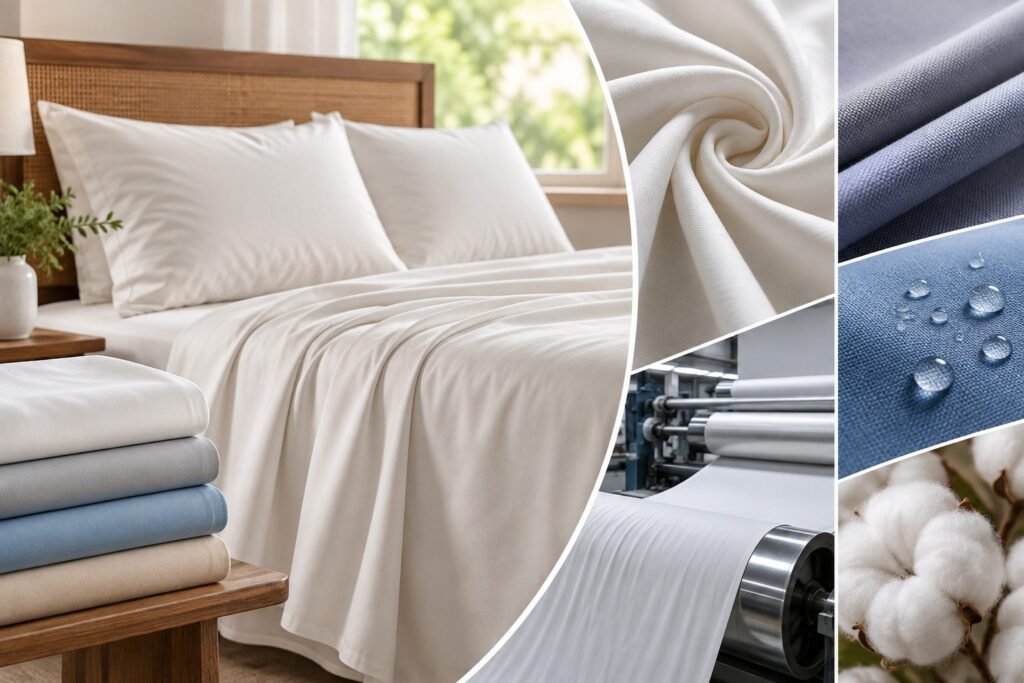
Bedsheet finishing plays an important role in the appearance, handfeel, performance and commercial positioning of bedding products. The same base fabric can have a significantly different look and feel depending on the finishing process used after weaving or knitting.
Scalane Global is a bedsheet manufacturer and exporter from India, supplying finished bedsheets and customized bedding products to importers, wholesalers, retailers, hotels, distributors, private-label brands and e-commerce businesses.
What Are Bedsheet Finishes?
A bedsheet finish refers to a physical, mechanical or chemical treatment applied to textile fabric to achieve specific characteristics.
Depending on the fabric and intended application, finishing can be used to improve:
- Softness
- Smoothness
- Appearance
- Dimensional stability
- Shrinkage control
- Wrinkle resistance
- Color appearance
- Surface texture
- Durability
- Ease of care
Not every finish is suitable for every fabric. The appropriate finishing process depends on the fiber composition, fabric construction, GSM, end use and buyer requirements.
Why Bedsheet Finishing Matters
Finishing can influence how a bedsheet feels when handled and how it performs after washing.
For international buyers, the finishing specification can be particularly important when developing:
- Retail bedding
- Premium bedding
- Hotel bedding
- Private-label collections
- E-commerce bedding
- Luxury home textiles
A buyer should evaluate the finished product rather than selecting a fabric based only on its raw construction.
Common Bedsheet Finishes
Common finishing treatments and processes include:
- Soft finish
- Silicone finish
- Enzyme wash
- Bio-polishing
- Mercerization
- Sanforization
- Wrinkle-resistant finish
- Peach finish
- Brushing
- Calendering
- Stone washing
- Garment washing
- Anti-pilling finish
- Moisture-management finishes
The availability and suitability of each process depend on the fabric.
Soft Finish for Bedsheets
A soft finish is used to improve the tactile feel of the fabric.
It can make a bedsheet feel:
- Softer
- Smoother
- More comfortable
- More pleasant against the skin
Soft finishes can be particularly relevant for cotton and blended bedding.
However, excessive finishing chemicals or unsuitable processing can affect absorbency, appearance or durability. The finishing process should therefore be selected according to the product’s intended performance.
Silicone Finish
Silicone finishing is commonly used to provide a smooth and soft handfeel.
Potential benefits include:
- Soft surface
- Smooth handfeel
- Improved drape
- Premium tactile appearance
Silicone finishing can be considered for bedding positioned as soft or premium.
The exact formulation and application level should be controlled to achieve consistent results.
Enzyme Wash for Bedsheets
Enzyme washing uses enzymes to modify the surface of suitable textile fibers.
For cotton fabrics, it can help create a smoother surface and reduce unwanted surface fibers.
Potential benefits include:
- Softer handfeel
- Cleaner surface
- Reduced fuzz
- Improved appearance
The treatment must be properly controlled because excessive processing can affect fabric strength.
Bio-Polishing
Bio-polishing is a finishing treatment commonly associated with cellulosic fabrics.
It can reduce surface fuzz and create a cleaner, smoother appearance.
Potential benefits include:
- Reduced pilling tendency
- Smoother surface
- Cleaner appearance
- Improved handfeel
The actual result depends on fabric construction and processing conditions.
Mercerization of Cotton Bedsheets
Mercerization is a treatment used on cotton that can improve certain properties of the fiber.
It can contribute to:
- Improved luster
- Better dye affinity
- Smooth appearance
- Increased dimensional stability in appropriate processes
Mercerized cotton may be used for higher-end bedding products where appearance and fabric performance are important.
Sanforization and Shrinkage Control
Sanforization is a mechanical compressive shrinkage-control process used primarily for cotton and suitable woven fabrics.
It is intended to reduce residual shrinkage.
Shrinkage control is particularly important for bedsheets because consumers expect the product dimensions to remain reasonably stable after washing.
Buyers can specify dimensional stability requirements according to the intended market.
Wrinkle-Resistant Finishing
Wrinkle-resistant treatments are designed to reduce the tendency of fabric to develop creases.
They can be useful for:
- Easy-care bedding
- Hospitality products
- Commercial bedding
- Retail products
The buyer should specify the required performance and ensure that the selected treatment is appropriate for the fabric and intended use.
Peach Finish
A peach finish creates a soft, slightly brushed surface that can provide a distinctive tactile effect.
It may be used on selected fabrics to create:
- Soft handfeel
- Smooth surface
- Slightly raised texture
- Warm tactile appearance
Peach finishing is particularly relevant when a softer, brushed feel is desired.
Brushed Bedsheets
Brushing mechanically raises or modifies fibers on the fabric surface.
Depending on the fabric, brushing can create:
- Softer handfeel
- Warmer surface
- Slightly fuzzy texture
Brushed bedding can be positioned differently from crisp percale or smooth sateen products.
Calendering
Calendering passes fabric between rollers under controlled pressure and, in some cases, heat.
It can affect:
- Smoothness
- Surface appearance
- Luster
- Compactness
Calendering can be used to create a more polished surface appearance.
Stone Washing
Stone washing creates a washed and relaxed appearance.
It may be used for selected bedding products where a casual or lived-in look is desired.
Possible characteristics include:
- Softer handfeel
- Washed appearance
- Casual aesthetic
- Reduced stiffness
The process must be controlled to maintain the required fabric strength and dimensions.
Garment Washing
Garment washing is carried out after the textile product has been constructed.
For certain bedding products, washing can create a softer and more relaxed appearance.
Potential benefits include:
- Soft handfeel
- Washed appearance
- Reduced stiffness
- Distinctive product character
The process should be evaluated for dimensional stability and color performance.
Anti-Pilling Finish
Anti-pilling treatments can help reduce the formation of small fiber balls on the fabric surface.
Pilling can be affected by:
- Fiber type
- Yarn construction
- Fabric construction
- Finishing
- Washing conditions
- Usage
An anti-pilling finish is only one part of overall pilling performance.
Moisture-Management Finishes
Certain textile finishes can be designed to influence moisture transport.
These may be considered for bedding marketed around:
- Breathability
- Comfort
- Moisture management
- Warm-weather use
Any performance claims should be supported by appropriate product testing.
Finishes for Cotton Bedsheets
Cotton bedsheets can use a range of finishing processes depending on the desired product.
Potential options include:
- Soft finish
- Silicone finish
- Enzyme wash
- Bio-polishing
- Mercerization
- Sanforization
- Calendering
- Wrinkle-resistant finishing
The final finish should be selected according to the fabric construction and intended market.
Finishes for Polycotton Bedsheets
Polycotton requires a different finishing approach because it contains both cotton and polyester fibers.
Potential finishing objectives include:
- Softness
- Easy care
- Wrinkle control
- Dimensional stability
- Surface smoothness
The exact process depends on the blend ratio and fabric construction.
Finishes for Linen Bedsheets
Linen can be finished to achieve different tactile and visual effects.
Possible approaches include:
- Softening
- Washing
- Enzyme treatment where appropriate
- Calendering
- Mechanical finishing
Washed linen products can provide a relaxed, natural appearance.
Finishes for Microfiber Bedsheets
Microfiber is a synthetic textile, so its finishing requirements differ from cotton and linen.
Finishing can be used to influence:
- Softness
- Smoothness
- Surface appearance
- Drape
- Static characteristics
The finish should be compatible with the specific microfiber construction.
Crisp vs Soft Bedsheet Finishes
Different consumers prefer different tactile characteristics.
Crisp Finish
A crisp bedsheet may provide:
- Fresh handfeel
- Structured appearance
- Smooth surface
- Hotel-style presentation
Soft Finish
A softer bedsheet may provide:
- Comfortable handfeel
- More relaxed drape
- Smooth tactile experience
- Casual or premium positioning
The choice should be based on the target consumer and french product positioning.
Matte vs Lustrous Finishes
Finishing can influence the visual appearance of bedding.
Matte Appearance
Often preferred for:
- Natural bedding
- Minimalist collections
- Linen products
- Casual bedding
Lustrous Appearance
Can be suitable for:
- Premium bedding
- Sateen products
- Luxury collections
- Decorative bedding
The base fabric construction remains an important factor in the final appearance.
Washed vs Unwashed Bedsheets
Washed bedding can have a softer and more relaxed appearance.
Unwashed or minimally washed bedding may retain a more structured appearance.
The choice depends on:
- Product positioning
- Fabric
- Target market
- Retail concept
- Consumer expectations
Bedsheet Finish and Shrinkage
Shrinkage should be evaluated after finishing because some treatments can affect fabric dimensions.
Buyers should establish:
- Length shrinkage tolerance
- Width shrinkage tolerance
- Washing temperature
- Washing method
- Drying conditions
Finished samples should be tested under conditions representative of the target market.
Bedsheet Finish and Color
Finishing can influence the final appearance of dyed or printed fabrics.
Buyers should evaluate:
- Shade
- Surface appearance
- Color consistency
- Print appearance
- Colorfastness
For printed bedsheets, the finishing process should be compatible with the selected printing technology.
Bedsheet Finish and Handfeel
Handfeel is subjective, but it can be evaluated using physical samples.
Buyers should compare:
- Softness
- Smoothness
- Crispness
- Weight
- Drape
- Surface texture
For repeat orders, an approved physical sample can be retained as a reference.
Bedsheet Finish Quality Control
Quality control can include:
Fabric
- GSM
- Width
- Construction
- Composition
- Surface appearance
Finishing
- Handfeel
- Shrinkage
- Surface uniformity
- Color appearance
- Wrinkle performance where applicable
Finished Product
- Dimensions
- Stitching
- Seams
- Hems
- Overall appearance
Testing Bedsheet Finishes
Depending on the buyer’s requirements, finished bedding can be evaluated for:
- Dimensional stability
- Shrinkage
- Colorfastness
- Pilling
- Tensile strength
- Seam performance
- Other applicable performance characteristics
Testing requirements should be established according to the destination market and buyer specification.
For international standards information:
International Organization for Standardization (ISO)
For textile safety and certification information:
Bedsheet Finishing for Private Label
Private-label brands can specify the desired finish as part of their product development.
A specification may include:
Fabric + GSM + Construction + Color + Finish + Dimensions + Packaging
For example, a buyer may request a cotton bedsheet with a soft finish, controlled shrinkage and customized retail packaging.
The actual finishing method should be selected after evaluating the fabric and required performance.
Bedsheet Finishing for Hotels
Hotel bedding may require a balance between:
- Softness
- Durability
- Dimensional stability
- Easy care
- Laundry performance
- Cost
Commercial laundry conditions should be considered when selecting a finishing process.
Bedsheet Finishing for E-Commerce Products
For online bedding brands, tactile characteristics cannot be directly experienced by the consumer before purchase.
Product descriptions therefore need to accurately communicate characteristics such as:
- Soft
- Crisp
- Washed
- Smooth
- Brushed
- Lightweight
- Premium
These descriptions should reflect the actual physical product.
Bedsheet Finish and Sustainability
Buyers increasingly evaluate textile processing from a sustainability perspective.
When discussing finishing, consider:
- Chemical inputs
- Water consumption
- Energy consumption
- Wastewater management
- Process efficiency
- Required certifications
Sustainability claims should be based on documented product or process information rather than generic marketing statements.
For information on responsible textile and fiber sourcing:
How to Select the Right Bedsheet Finish
A practical selection process is:
1. Select the fabric
Cotton, linen, polycotton, microfiber or another material.
2. Define the handfeel
Crisp, soft, smooth, brushed or relaxed.
3. Define the appearance
Matte, natural, polished, washed or lustrous.
4. Define performance
Shrinkage, pilling, wrinkle resistance, durability and wash performance.
5. Consider the market
Retail, hospitality, premium, value or e-commerce.
6. Approve a physical sample
Evaluate the finished product before bulk manufacturing.
Bedsheet Finishing Manufacturer India
Scalane Global can discuss bedsheet manufacturing and finishing requirements for international buyers.
Depending on the fabric and product specification, buyers can discuss:
- Cotton bedsheets
- Polycotton bedsheets
- Linen bedsheets
- Microfiber bedsheets
- Printed bedsheets
- Solid-color bedsheets
- Hotel bedding
- Private-label bedding
- OEM bedding
Finishing specifications can be incorporated into the product development process.
Bedsheet Finish MOQ
MOQ depends on:
- Fabric
- Finish
- Color
- Size
- Quantity
- Number of SKUs
- Packaging
- Customization
Custom finishing requirements may affect production minimums and development costs.
Bedsheet Finish Cost
Finishing cost depends on:
- Type of finish
- Fabric
- GSM
- Quantity
- Processing requirements
- Color
- Washing requirements
- Additional testing
- Packaging
Therefore, finishing cost should be calculated as part of the complete product specification.
How to Order Finished Bedsheets from India
The typical process is:
Inquiry → Fabric Selection → Finish Selection → Sample Development → Testing/Evaluation → Approval → Bulk Production → Quality Control → Packaging → Export
For private-label and OEM programs, branding and packaging are also finalized before production.
Bedsheet Finish Buyer Specification
For an accurate quotation, buyers should provide:
Fabric: Cotton / Polycotton / Linen / Microfiber / Other
Composition: Required percentage
GSM: Required GSM
Construction: Weave and fabric specification
Finish: Soft / Silicone / Washed / Brushed / Other
Handfeel: Crisp / Soft / Smooth / Relaxed
Color: Required color or reference
Size: Finished dimensions
Quantity: Pieces or sets
Packaging: Bulk / Retail / Private Label
Destination: Country and port/city
Testing: Required tests, if applicable
If you do not have a complete technical specification, send a sample, photograph or existing product reference.
Frequently Asked Questions
What is the best finish for bedsheets?
There is no single best finish. The appropriate finish depends on the fabric, desired handfeel, appearance, performance and target market.
What finish makes cotton bedsheets softer?
Softening, silicone finishing, enzyme washing and other suitable finishing processes can improve the handfeel of cotton, depending on the fabric and processing conditions.
What is Sanforization?
Sanforization is a controlled mechanical process used to reduce residual shrinkage in suitable woven fabrics, particularly cotton.
Does finishing affect bedsheet shrinkage?
Yes. Finishing can influence dimensional stability, which is why finished products should be tested for shrinkage.
Can I specify the finish for my private-label bedsheets?
Yes. Buyers can specify the desired handfeel and performance, and the appropriate finishing process can be evaluated during product development.
Can hotel bedsheets have special finishes?
Yes. Hotel bedding can be developed with finishing requirements focused on softness, durability, dimensional stability and commercial laundry performance.
Can you make washed linen bedsheets?
Washed linen and linen-blend bedding can be developed according to the required fabric, appearance and finishing specification.
Can I receive a finished sample before bulk production?
Yes. A physical finished sample should be approved before bulk production.
Request a Bedsheet Manufacturing Quote
If you are an importer, wholesaler, retailer, distributor, hotel supplier, private-label brand or e-commerce company, contact Scalane Global to discuss finished bedsheet manufacturing and export from India.
Send us your:
- Fabric
- Composition
- GSM
- Construction
- Desired finish
- Handfeel
- Color
- Size
- Quantity
- Packaging
- Branding requirements
- Destination market
You can also send a sample, photograph, product specification or existing reference.
Request a Quote | Request Samples | Request Catalogue | Discuss Private Label | Discuss OEM | WhatsApp Us