
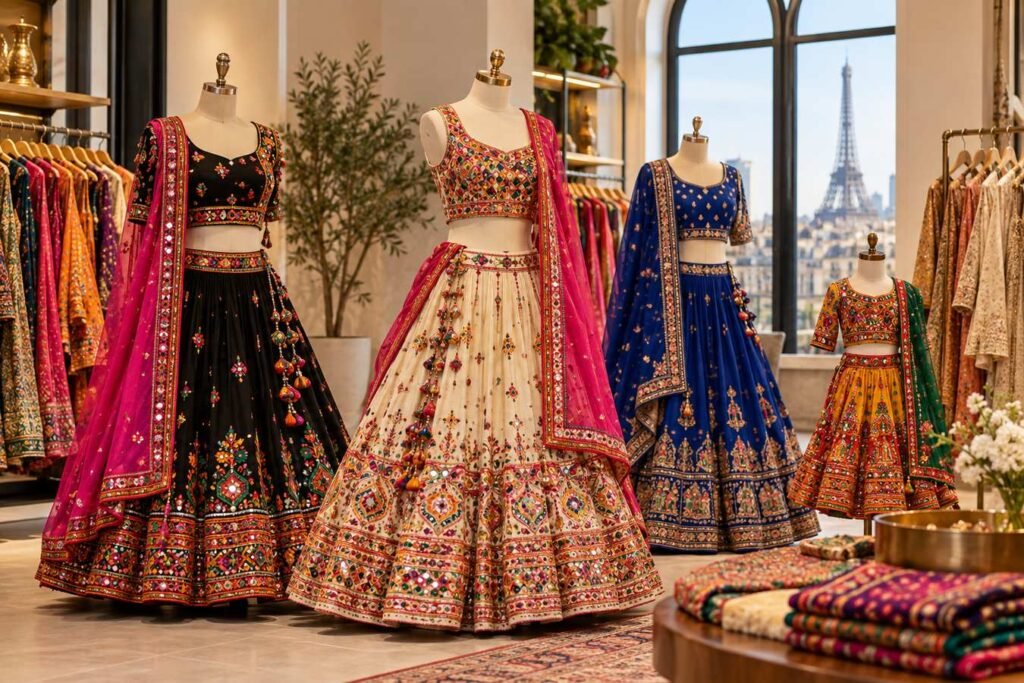
Chaniya Choli Wholesale Europe from India
Scalane Global offers Chaniya Choli wholesale for Europe for retailers, boutiques, wholesalers, distributors, importers, ethnicwear stores, online fashion businesses and other B2B buyers looking to develop Indian ethnicwear collections for European markets.
Wholesale collections can be developed around traditional Gujarati Chaniya Choli, Garba styles, Navratri collections, mirror-work designs, embroidered Chaniya Choli, Bandhani combinations, cotton Chaniya Choli, contemporary festivewear, children’s collections and extended-size options.
European buyers can select from suitable existing collections or develop products around specific requirements for design, fabric, colour, sizing, embellishment, branding and packaging.
The objective is to create commercially practical wholesale collections rather than simply supplying individual garments.
Chaniya Choli Wholesale for European B2B Buyers
The European market includes different types of buyers with different purchasing requirements.
Scalane Global can develop Chaniya Choli wholesale collections for:
- Fashion retailers
- Ethnicwear retailers
- Indian clothing stores
- Boutiques
- Wholesalers
- Distributors
- Importers
- Online fashion businesses
- E-commerce retailers
- Festival-focused retailers
- Indian diaspora-focused businesses
- Cultural and event-oriented businesses
- Private-label fashion brands
A boutique may need a curated collection with limited designs and stronger visual differentiation.
A wholesaler may require greater SKU depth, multiple sizes and colours, and repeat availability.
An online fashion business may require organized variants, consistent measurements and individual product packaging.
An importer may focus on assortment, commercial quantities, documentation, shipping and landed cost.
The wholesale program should therefore be designed around the buyer’s actual business model.
Why Source Chaniya Choli from India for European Wholesale?
India has established textile, apparel and handicraft manufacturing capabilities, including traditional and contemporary Indian ethnicwear.
For European B2B buyers, sourcing Chaniya Choli from India can provide access to:
- Gujarati-inspired designs
- Traditional Indian textile techniques
- Mirror-work decoration
- Embroidery
- Bandhani combinations
- Cotton-based collections
- Festivewear
- Garba-oriented designs
- Navratri collections
- Custom product development
- Private-label manufacturing
- OEM manufacturing
Working directly with an India-based manufacturer and exporter can also allow buyers to discuss product specifications before production rather than purchasing only from a uae finished-goods intermediary.
European Chaniya Choli Wholesale Collection
A wholesale collection can be divided into clear product groups.
This helps buyers maintain variety without making the assortment unnecessarily complicated.
Traditional Chaniya Choli
Traditional collections can include:
- Gujarati-inspired Chaniya Choli
- Traditional festive designs
- Mirror-work Chaniya Choli
- Embroidered Chaniya Choli
- Bandhani combinations
- Traditional borders
- Decorative motifs
- Coordinated dupattas
These products can be positioned for ethnicwear stores, Indian fashion retailers, boutiques and canada festive collections.
Garba Chaniya Choli
Garba-oriented collections can focus on garments designed around the visual character of Garba and Indian festivewear.
Possible product directions include:
- Mirror-work Garba Chaniya Choli
- Embroidered Garba styles
- Traditional Gujarati designs
- Colourful festive collections
- Contemporary Garba designs
- Coordinated family collections
- Kids’ Garba Chaniya Choli
This category can be particularly relevant to retailers serving customers interested in Indian cultural celebrations.
Navratri Chaniya Choli
Navratri collections can be developed around seasonal purchasing requirements.
Possible collections include:
- Traditional Navratri Chaniya Choli
- Mirror-work festive designs
- Embroidered designs
- Colour-led collections
- Gujarati-inspired collections
- Garba collections
- Women’s collections
- Kids’ collections
- Coordinated family options
For wholesale buyers, seasonal collections should be planned sufficiently ahead of the intended selling period to allow for sampling, production, export and local distribution.
Mirror Work Chaniya Choli Wholesale
Mirror work is an important decorative direction for Chaniya Choli collections.
Wholesale buyers can specify:
- Mirror-work density
- Mirror size
- Mirror placement
- Motif design
- Border decoration
- Embroidery combinations
- Colour combinations
- Chaniya decoration
- Choli decoration
- Dupatta decoration
Different levels of decoration can be developed for different retail positions.
A buyer may choose a relatively simple mirror-work collection for regular ethnicwear retail and more heavily decorated designs for festive or Navratri collections.
The exact construction should be confirmed through product samples before bulk production.
Embroidered Chaniya Choli Wholesale
Embroidery provides another route for developing differentiated wholesale collections.
Possible embroidery directions include:
- Floral motifs
- Geometric motifs
- Traditional-inspired motifs
- Border embroidery
- Panel embroidery
- Choli embroidery
- Dupatta embroidery
- Thread-based decoration
- Embroidery combined with mirror work
European buyers can define the preferred visual direction according to their target customer and collection positioning.
For custom programs, buyers can provide reference images, sketches, colour references or other design information.
Bandhani Chaniya Choli Wholesale
Bandhani can be incorporated into Chaniya Choli collections through appropriate fabric and design combinations.
Possible approaches include:
- Bandhani Chaniya
- Bandhani dupatta
- Bandhani-inspired colour combinations
- Bandhani with mirror work
- Bandhani with embroidery
- Traditional Gujarati combinations
- Contemporary Bandhani-inspired collections
Where authentic Bandhani is specifically required, the buyer should clearly identify the required textile technique and product specification during sampling and approval.
This distinction is important because a Bandhani-inspired printed or decorative design is not automatically equivalent to an authentic Bandhani textile technique.
Cotton Chaniya Choli Wholesale Europe
Cotton Chaniya Choli can be developed for buyers looking for cotton-based Indian ethnicwear collections.
Product development can consider:
- Cotton fabric construction
- Fabric weight
- Surface appearance
- Colour
- Embroidery
- Mirror work
- Borders
- Chaniya flare
- Choli construction
- Dupatta
- Size range
Cotton collections can range from relatively simple designs to more decorated festive products.
The appropriate fabric should be selected according to the intended garment design and buyer specification.
Contemporary Chaniya Choli for European Buyers
Not every European buyer will require a heavily traditional collection.
Contemporary collections can combine Indian design references with modern styling.
Possible directions include:
- Cleaner silhouettes
- Simplified decoration
- Modern colour combinations
- Contemporary blouse designs
- Reduced mirror-work density
- Modern embroidery
- Updated borders
- Coordinated separates
- Traditional and contemporary fusion
This can help fashion businesses create collections that retain an Indian visual identity while fitting their own merchandising strategy.
Kids Chaniya Choli Wholesale EuropeChildren’s Chaniya Choli can be included as a separate product group within a wholesale collection.
Possible applications include:
- Navratri
- Garba
- Dandiya
- Indian festivals
- Family collections
- Mother-and-daughter collections
- Children’s ethnicwear
Buyers can specify:
- Age groups
- Size range
- Colour combinations
- Fabric
- Embroidery
- Mirror work
- Bandhani
- Chaniya length
- Choli design
- Dupatta requirements
For children’s products, the final construction and decorative components should be evaluated appropriately for the intended age group and destination-market requirements.
Extended-Size Chaniya Choli Wholesale
European buyers may also require broader size coverage for their customer base.
An extended-size collection can be developed around:
- Defined body measurements
- Size grading
- Choli proportions
- Chaniya waist
- Chaniya flare
- Garment length
- Dupatta dimensions
- Fit requirements
For custom manufacturing, the buyer should provide a clear measurement chart.
The approved measurement specification should then be used as the production reference.
European Wholesale Collection Planning
A commercially practical collection should be planned before bulk production.
A buyer can divide the assortment into:
Core Collection
Products intended to remain commercially relevant across multiple selling periods.
Festive Collection
Products intended for Navratri, Garba and other Indian festive occasions.
Fashion Collection
More contemporary or design-led products intended to attract customers seeking updated styling.
Children’s Collection
Selected children’s designs that coordinate with the main collection.
Extended-Size Collection
Selected designs offered in a broader size range.
This structure allows the buyer to create variety without automatically manufacturing every design in every colour and size.
Colour Planning for European Wholesale Orders
Colour planning should consider the overall collection rather than treating every garment separately.
A wholesale collection can include:
- Traditional colour combinations
- Bright festive colours
- Jewel-inspired colours
- Pastel combinations
- Contrasting colours
- Tonal combinations
- Contemporary neutrals
- Seasonal colour stories
A useful commercial structure can be:
Core colours + supporting colours + statement colours
This gives buyers visual variety while keeping the assortment more manageable.
The final colour palette should be confirmed through samples or approved colour references where colour accuracy is commercially important.
Fabric Selection for European Chaniya Choli
Fabric selection affects appearance, comfort, drape, garment construction and final product positioning.
Depending on the design, buyers may consider:
- Cotton
- Rayon
- Georgette
- Silk or silk blends
- Poly-cotton
- Other suitable textile constructions
The fabric should be selected according to:
- Garment design
- Intended use
- Decoration
- Weight
- Drape
- Durability
- Target customer
- Desired price positioning
- Destination-market requirements
For export orders, the buyer should confirm any required material, composition or product-information specifications before production.
Chaniya, Choli and Dupatta Coordination
A Chaniya Choli collection should be considered as a complete coordinated product.
Chaniya
Important considerations include:
- Flare
- Length
- Waist construction
- Panels
- Fabric
- Borders
- Embroidery
- Mirror work
- Motifs
Choli
Consider:
- Neckline
- Sleeve design
- Length
- Fit
- Embroidery
- Mirror work
- Fastenings where applicable
- Measurement chart
Dupatta
Consider:
- Fabric
- Dimensions
- Border
- Embroidery
- Mirror work
- Colour coordination
- Finishing
The three components should be evaluated together during sample development.
Custom Chaniya Choli Wholesale for Europe
European wholesale buyers may require products that differ from a standard ready collection.
Custom wholesale development can involve:
- Custom designs
- Custom colours
- Custom fabrics
- Custom embroidery
- Custom mirror-work placement
- Custom borders
- Custom measurements
- Custom size ranges
- Custom labels
- Custom packaging
The buyer can provide:
- Product photographs
- Sketches
- Existing garments
- Mood boards
- Colour references
- Measurement charts
- Embroidery references
The manufacturing process can then move through sample development, review, revisions where required and final approval before bulk production.
Private Label Chaniya Choli Wholesale Europe
European fashion businesses can develop Chaniya Choli under their own brand through private-label manufacturing.
A private-label program may include:
- Brand labels
- Hangtags
- Product codes
- Custom packaging
- Buyer-specific designs
- Custom colours
- Custom embellishment
- Size specifications
- Seasonal collections
Private label is particularly relevant for fashion businesses that want to sell the collection under their own brand identity.
The branding specifications should be confirmed before production.
OEM Chaniya Choli Wholesale Europe
OEM manufacturing is suitable when the buyer has defined product specifications.
The specification may include:
- Design
- Fabric
- Colour
- Measurements
- Size grading
- Embroidery
- Mirror work
- Borders
- Trims
- Labels
- Packaging
The approved specification becomes the manufacturing reference.
OEM can therefore be useful for European businesses that already have an established product concept and need manufacturing according to their requirements.
Sampling for European Wholesale Buyers
Samples allow buyers to evaluate the actual product before larger production.
A sample review can include:
- Fabric
- Colour
- Fit
- Measurements
- Chaniya flare
- Choli construction
- Dupatta
- Embroidery
- Mirror work
- Borders
- Finishing
- Overall appearance
For custom or private-label collections, the sample should be reviewed against the buyer’s original specification.
Once the sample is approved, important specifications should be documented before production begins.
Quality Control for Wholesale Chaniya Choli
Quality control can cover multiple stages of the manufacturing process.
Important checkpoints include:
Fabric
- Material consistency
- Colour consistency
- Visible defects
- Surface appearance
Stitching
- Seam quality
- Thread finishing
- Construction
- Loose threads
Chaniya
- Waist
- Flare
- Length
- Panels
- Borders
- Decorative elements
Choli
- Measurements
- Neckline
- Sleeves
- Stitching
- Finishing
Dupatta
- Dimensions
- Borders
- Decoration
- Edge finishing
Embroidery and Mirror Work
- Placement
- Stitching
- Decorative consistency
- Loose components
- Missing elements
- Finishing
Final Product
- Size identification
- Product coding
- Overall appearance
- Packaging
- Quantity verification
For custom orders, quality should be evaluated against the approved sample and specification.
Wholesale Packaging for European Buyers
Export packaging should be discussed before production.
Depending on the buyer’s requirements, packaging can include:
- Individual garment packing
- Size identification
- Product codes
- Design codes
- Colour identification
- Inner packaging
- Master cartons
- Carton markings
- Buyer-specific labels
- Private-label packaging
A structured packing system can help buyers manage multiple designs, sizes and colours after receiving the shipment.
For example:
Product Code → Colour → Size → Quantity
This can simplify warehouse receiving and stock management.
European Buyer Segments
Retailers
Retailers can select a balanced collection covering:
- Traditional designs
- Gujarati styles
- Garba collections
- Navratri collections
- Mirror work
- Embroidery
- Kids
- Extended sizes
Boutiques
Boutiques may focus on:
- Curated collections
- Distinctive designs
- Designer-oriented products
- Limited colour stories
- Custom development
- Private label
Wholesalers
Wholesalers may require:
- Multiple designs
- Multiple colours
- Multiple sizes
- Greater SKU depth
- Repeat availability
- Organized packaging
Distributors
Distributors supplying multiple retailers may prioritize:
- Consistent specifications
- Assortment depth
- Product coding
- Repeat availability
- Standardized packaging
Online Fashion Businesses
Online businesses may require:
- Consistent measurements
- Size charts
- Product codes
- Variant management
- Individual packaging
- Repeatable product specifications
- Collection photography and product information
Importers
Importers may focus on:
- Product assortment
- Commercial quantities
- Documentation
- Shipping
- Customs planning
- Landed cost
- Replenishment
European Seasonal Wholesale Planning
Navratri and Garba demand should be treated as planned seasonal inventory rather than a last-minute purchase.
A wholesale program can move through:
Collection planning → Sample development → Approval → Purchase order → Production → Quality control → Packaging → Export → Import clearance → Local distribution → Retail launch
The exact timeline depends on:
- Number of designs
- Quantity
- Customization
- Fabric availability
- Embroidery
- Mirror work
- Branding
- Packaging
- Shipping method
- Destination country
European buyers should therefore communicate their intended selling period during the quotation stage.
Building a Repeat Wholesale Program
A repeat wholesale relationship can combine existing approved designs with new collection development.
For example:
Existing Collection
Retain proven designs where commercially appropriate.
New Colours
Introduce new colour combinations without changing the complete design.
New Decoration
Refresh selected products through embroidery, mirror-work or border changes.
Seasonal Designs
Add new Navratri and Garba-focused products.
New Silhouettes
Introduce selected contemporary designs.
This approach can create collection freshness while retaining recognizable products.
What European Buyers Should Include in a Wholesale Inquiry
To receive a relevant quotation, buyers should provide:
Company Information
- Company name
- Buyer type
- Country
- Website
- Sales channel
Product Requirements
- Chaniya Choli category
- Number of designs
- Quantity
- Fabric
- Colours
- Embroidery
- Mirror work
- Bandhani
- Size range
- Kids’ requirements
- Extended-size requirements
Commercial Requirements
- Ready collection or custom
- Private label or standard wholesale
- OEM requirement
- Packaging requirement
- Branding requirement
- Intended delivery period
- Destination country
- Preferred shipping arrangement
Reference Material
- Product photographs
- Sketches
- Mood boards
- Measurement charts
- Colour references
- Branding guidelines
A complete inquiry allows the manufacturer to understand the intended collection before discussing production and commercial terms.
Start Your Chaniya Choli Wholesale Inquiry for Europe
European retailers, boutiques, wholesalers, distributors, importers and online fashion businesses can share their Chaniya Choli requirements with Scalane Global.
Whether the requirement is a traditional Gujarati collection, Garba and Navratri assortment, mirror-work range, embroidered collection, cotton Chaniya Choli, kids’ range, extended-size collection, private label or OEM program, the product specification can be developed around the buyer’s requirements.
Share your designs, quantity, sizes, fabrics, colours, branding and destination country to begin a Chaniya Choli wholesale inquiry for Europe.
Europe-Specific Wholesale Planning for Chaniya Choli
European wholesale buyers often operate across different countries, sales channels and customer groups. A Chaniya Choli collection intended for Europe should therefore be planned around the specific destination market, buyer model, product specifications and import requirements rather than treating Europe as one identical retail market.
For buyers sourcing from India, the commercial process can be structured around:
Product selection → specification → sampling → approval → production → quality control → packaging → export documentation → shipping → import clearance → local distribution
The exact requirements can vary according to the destination country, product composition, transaction structure and applicable regulations.
Choosing the Right Chaniya Choli Assortment for Europe
A European wholesale collection can be structured into several commercial layers.
Core Collection
Products suitable for ongoing ethnicwear sales.
Festival Collection
Products developed around Navratri, Garba and Indian festive occasions.
Fashion Collection
Contemporary designs aimed at customers looking for updated Indian fashion.
Children’s Collection
Selected kids’ products that complement the women’s range.
Extended-Size Collection
Selected designs available across a broader size range.
This structure can help buyers create a balanced assortment without producing every design in every possible variant.
Country-Level Planning Within Europe
A buyer selling in Germany may have different customer demographics and retail requirements from a boutique selling in France, the Netherlands, Italy, Spain or another European market.
For this reason, a European wholesale order should identify the actual destination country.
The buyer should communicate:
- Destination country
- Delivery location
- Sales channel
- Customer profile
- Intended product category
- Expected selling period
- Required size range
- Product labelling requirements
- Packaging requirements
- Import arrangements
This allows product and shipping planning to be evaluated against the actual destination rather than a generic “Europe” assumption.
European Union and Non-EU Destinations
Europe is not synonymous with the European Union.
This distinction matters for international trade planning.
A buyer should identify whether the shipment is destined for:
- An EU member state
- The United Kingdom
- Switzerland
- Norway
- Another European market
The applicable import, customs, tax, product and documentation requirements can differ between destinations.
Therefore, the commercial quotation should identify the specific destination country rather than assuming that one customs or tax treatment applies throughout Europe.
EU Import Planning for Chaniya Choli
For shipments entering the European Union, buyers should verify the applicable requirements before placing a commercial order.
Important areas can include:
- Correct tariff classification
- Customs valuation
- Country of origin
- Import documentation
- Product composition
- Textile-related information
- Labelling
- Packaging
- Applicable taxes
- Importer responsibilities
- Destination-country requirements
The EU’s official Access2Markets platform provides information on tariffs, taxes, import procedures, product requirements and trade-related conditions for goods entering the EU. Buyers should use the destination country and product classification to verify the applicable requirements before finalizing a shipment.
Because tariff classification can depend on the actual product construction and composition, buyers should confirm the applicable HS/CN classification rather than relying on a generic clothing code.
Textile Fibre Composition and European Labelling
For textile products sold in the European Union, fibre-composition information is an important compliance consideration.
The EU textile labelling framework requires textile products placed on the EU market to identify their fibre composition in accordance with the applicable rules.
For Chaniya Choli, the buyer should therefore establish the actual composition of the:
- Chaniya
- Choli
- Dupatta
- Decorative textile components where relevant
If a garment contains different textile fibres, the composition should be established accurately before final labelling.
The manufacturer and buyer should agree on the product information required for the destination market before production.
Where specific EU labelling requirements apply, buyers should verify the final wording and implementation with their importer or compliance adviser.
Product Safety and Destination-Market Requirements
Clothing products sold in Europe can be subject to general product-safety and chemical-related requirements in addition to textile composition labelling.
The exact obligations can depend on:
- Product construction
- Materials
- Dyes
- Prints
- Decorative components
- Intended user
- Children’s products
- Packaging
- Claims made about the product
This is particularly relevant when developing:
- Children’s Chaniya Choli
- Products with extensive decoration
- Mirror-work products
- Products containing metal components
- Products with printed or treated textiles
For European B2B orders, buyers should identify any destination-market compliance requirements during the specification stage rather than after manufacturing.
Children’s Chaniya Choli for Europe
Children’s garments require additional attention because the intended user group can affect applicable product-safety requirements.
For children’s Chaniya Choli, buyers should consider:
- Age range
- Garment construction
- Decorative components
- Attachment of embellishments
- Drawstrings or cords where applicable
- Small components
- Fabric composition
- Labelling
- Packaging
- Destination-market requirements
A buyer developing children’s products for the European market should provide the intended age range and required specifications at the beginning of the product-development process.
Where compliance testing or documentation is required, the buyer should establish those requirements before bulk production.
Mirror Work and Decorative Components
Mirror work gives Chaniya Choli its distinctive visual character, but decorative components should be considered during product development and quality control.
Buyers can specify:
- Mirror size
- Mirror placement
- Density
- Embroidery around mirrors
- Border treatment
- Decorative motifs
- Choli embellishment
- Chaniya embellishment
- Dupatta embellishment
For export production, the attachment and finishing of decorative elements should be reviewed carefully.
For children’s products in particular, the buyer should communicate any applicable destination-market safety requirements before approving the design.
European Wholesale Packaging
Packaging requirements should be established before production.
Depending on the buyer’s operation, packaging can include:
- Individual garment packing
- Product labels
- Size labels
- Product codes
- Colour identification
- Inner cartons
- Master cartons
- Carton markings
- Buyer-specific packaging
- Private-label packaging
For European distribution, carton organization can be designed around the buyer’s warehouse system.
For example:
SKU → Colour → Size → Quantity → Carton Number
This can make receiving and inventory management easier.
Packaging and Environmental Considerations
European buyers may have their own packaging policies in addition to applicable legal requirements.
Before production, buyers can specify:
- Packaging material
- Individual garment packaging
- Recyclable packaging preferences
- Carton specifications
- Packaging quantity
- Product labels
- Hangtags
- Barcode requirements
- Private-label packaging
The buyer should communicate any retailer-specific packaging standards before the order is finalized.
This is especially important when supplying large retail chains, online businesses or established fashion brands.
Country of Origin
For international shipments, the buyer should maintain accurate country-of-origin information.
Chaniya Choli manufactured in India should be represented accurately as originating from India where the applicable origin rules support that determination.
The appropriate origin documentation and marking requirements can depend on the destination country and transaction.
Buyers should therefore confirm their destination-market requirements before final packaging and documentation.
Customs Classification and Landed Cost
European buyers should avoid calculating landed cost solely from the factory quotation.
A practical landed-cost model can include:
Product cost + export-related charges + international freight + insurance where applicable + customs duty where applicable + import VAT/taxes + customs clearance + local transportation + other destination charges
The exact amount depends on:
- Product classification
- Product value
- Origin
- Destination
- Incoterm
- Shipping method
- Customs treatment
- Applicable taxes
- Clearance charges
The EU’s official Access2Markets database can be used to investigate destination-specific tariffs, taxes and import procedures once the relevant product classification and destination are known.
For a commercial quotation, buyers should clearly establish which costs are included and which remain payable at destination.
Incoterms for European Wholesale Orders
The agreed Incoterm should be clearly stated in the commercial quotation.
Possible terms discussed between international buyers and sellers can include:
- EXW
- FCA
- FOB
- CFR
- CIF
- DAP
- Other appropriate Incoterms
The relevant term determines the allocation of responsibilities and costs between buyer and seller.
Depending on the Incoterm, responsibilities can relate to:
- Export clearance
- Main transportation
- Insurance
- Import clearance
- Customs duties
- Import taxes
- Final delivery
Buyers should understand the destination-side obligations before accepting the quotation.
Shipping Chaniya Choli from India to Europe
The appropriate transportation method depends on order volume and commercial requirements.
Courier
Useful for:
- Samples
- Small quantities
- Product-development shipments
- Urgent documents
Air Freight
Can be considered for:
- Time-sensitive inventory
- Seasonal replenishment
- Smaller commercial consignments
- Higher-value garments
Sea Freight
Can be suitable for:
- Larger wholesale orders
- Higher-volume shipments
- Planned inventory
- Cost-sensitive transportation
The final transportation method should be evaluated after the buyer provides:
- Quantity
- Carton dimensions
- Destination
- Required delivery period
- Shipping preference
Seasonal Planning for European Navratri Collections
Navratri is a seasonal opportunity for Chaniya Choli businesses, but international buyers need to account for the entire supply chain.
A typical planning sequence is:
Market planning
↓
Design selection
↓
Sampling
↓
Approval
↓
Purchase order
↓
Production
↓
Quality control
↓
Packaging
↓
Export documentation
↓
International transportation
↓
Import clearance
↓
Local distribution
↓
Retail launch
The actual schedule depends on the size and complexity of the order.
Buyers should therefore communicate the required retail launch period as early as possible.
European Wholesale Inventory Strategy
A buyer does not necessarily need to purchase large quantities of every design.
A more controlled strategy can use:
Core SKUs
Higher-priority designs maintained consistently.
Seasonal SKUs
Products introduced around Navratri and other festive periods.
Test SKUs
Smaller initial quantities used to evaluate customer response where commercially appropriate.
Replenishment SKUs
Products that can be reordered when demand supports additional production.
This can reduce unnecessary inventory exposure while maintaining assortment variety.
Replenishment and Repeat Orders
Repeat orders can be easier when product specifications have already been approved.
For an established collection, the buyer can maintain:
- Product code
- Design reference
- Fabric
- Colour
- Measurements
- Decoration
- Size range
- Packaging
- Approved sample
A repeat order can then use the established specification while new designs are developed separately.
This can create a more structured long-term wholesale program.
European Private-Label Chaniya Choli
European fashion brands can develop private-label Chaniya Choli under their own branding.
Private-label programs can include:
- Brand labels
- Hangtags
- Custom packaging
- Product codes
- Custom colours
- Custom embroidery
- Custom mirror work
- Size specifications
- Seasonal collections
The brand’s requirements should be documented before bulk production.
Private label should remain distinct from standard wholesale: the purpose is not simply to purchase an existing product, but to develop and sell it under the buyer’s own brand identity.
European OEM Chaniya Choli
OEM manufacturing is appropriate when the buyer has a defined product specification.
The buyer may provide:
- Technical drawings
- Product photographs
- Measurement charts
- Fabric requirements
- Colour references
- Embroidery references
- Mirror-work specifications
- Labels
- Packaging requirements
The manufacturer can then develop samples against those specifications.
After approval, the approved specification becomes the reference for production.
Custom Chaniya Choli for European Wholesale Buyers
Custom manufacturing can be used where the buyer wants a product developed specifically for its market or collection.
Custom elements can include:
- Silhouette
- Fabric
- Colour
- Embroidery
- Mirror work
- Borders
- Motifs
- Chaniya flare
- Choli design
- Dupatta
- Sizing
- Labels
- Packaging
The custom-development process can begin with a buyer brief and reference material.
The final product should be approved before bulk manufacturing.
Quality Control Before Export
Before shipment, the buyer should have a defined quality-control checklist.
The inspection can consider:
Product
- Design conformity
- Fabric
- Colour
- Measurements
- Construction
Decoration
- Embroidery
- Mirror work
- Borders
- Motifs
- Loose threads
- Decorative consistency
Quantity
- SKU quantities
- Size quantities
- Colour quantities
Packaging
- Individual packaging
- Labels
- Product codes
- Cartons
- Carton markings
For custom orders, the approved sample should be the primary product reference.
European Buyer Checklist
Before placing a wholesale order, buyers should ideally prepare:
1. Destination
- Country
- City
- Delivery location
2. Buyer Type
- Retailer
- Boutique
- Wholesaler
- Distributor
- Importer
- Online business
- Fashion brand
3. Product
- Chaniya Choli type
- Number of designs
- Quantity
- Fabric
- Colours
- Embroidery
- Mirror work
- Bandhani
- Kids
- Extended sizes
4. Branding
- Standard wholesale
- Private label
- OEM
- Custom
5. Packaging
- Individual packaging
- Labels
- Hangtags
- Barcodes
- Carton specifications
6. Compliance
- Destination-market requirements
- Textile composition
- Labelling
- Product-safety requirements
- Children’s product requirements where applicable
7. Logistics
- Required delivery period
- Preferred shipping method
- Incoterm
- Destination
- Importer/clearance arrangements
Questions European Buyers Should Ask Before Ordering
A buyer can ask the manufacturer:
- Can you manufacture Chaniya Choli according to our specifications?
- Can you develop custom colours?
- Can you develop custom embroidery?
- Can you develop mirror-work designs?
- Can you manufacture Bandhani Chaniya Choli?
- Can you develop children’s collections?
- Can you provide extended sizes?
- Can you provide private-label manufacturing?
- Can you manufacture OEM products?
- Can you provide samples?
- How is quality controlled?
- How will the garments be packed?
- Can packaging be customized?
- What information is required for a shipping quotation?
- Which Incoterms can be offered?
- Can repeat orders be manufactured using an approved specification?
These questions can help buyers establish whether the manufacturing process matches their commercial requirements.
Common Mistakes When Buying Chaniya Choli Wholesale for Europe
Buying Without Identifying the Destination Country
European requirements are not necessarily identical across all markets.
Treating All European Customers the Same
Retail positioning, customer demographics and sales channels can differ substantially.
Not Confirming Product Composition
Textile composition should be established accurately before final labelling.
Ignoring Children’s Product Requirements
Children’s garments can require additional attention to safety and construction.
Ordering Too Many SKUs
Excessive design, colour and size combinations can create inventory complexity.
Leaving Packaging Until the End
Packaging and labelling requirements should be communicated before production.
Calculating Only Factory Cost
International freight, customs, taxes and local charges can affect landed cost.
Not Approving Samples
The final bulk product should be based on an approved specification.
Planning Navratri Inventory Too Late
International production and transportation require advance planning.
Frequently Asked Questions
What is Chaniya Choli Wholesale Europe?
Chaniya Choli Wholesale Europe refers to bulk B2B sourcing of Chaniya Choli collections for European retailers, boutiques, wholesalers, distributors, importers and online fashion businesses.
Can European buyers source Chaniya Choli from India?
Yes. European B2B buyers can source Chaniya Choli from Indian manufacturers and exporters for standard wholesale, custom manufacturing, private-label and OEM programs.
What types of Chaniya Choli are available for European wholesale?
Collections can include traditional Gujarati, Garba, Navratri, mirror-work, embroidered, Bandhani, cotton, contemporary, kids and extended-size Chaniya Choli.
Can European buyers order custom Chaniya Choli?
Yes. Custom development can cover design, fabric, colour, measurements, embroidery, mirror work, borders, sizing, labels and packaging.
Can European fashion brands order private-label Chaniya Choli?
Yes. Private-label collections can be developed around the buyer’s brand identity, product requirements, labels and packaging.
Can European buyers order OEM Chaniya Choli?
Yes. OEM production can be developed according to buyer-defined specifications for design, fabric, colour, measurements, decoration and packaging.
Can European buyers order children’s Chaniya Choli?
Yes. Children’s collections can be developed for Garba, Navratri, festivals and Indian ethnicwear markets. Destination-market safety and product requirements should be confirmed before production.
Can European buyers order extended-size Chaniya Choli?
Yes. Extended-size collections can be developed using an agreed measurement chart and size-grading specification.
Is Chaniya Choli subject to textile labelling requirements in the EU?
EU textile products can be subject to fibre-composition and labelling requirements. Buyers should verify the current requirements applicable to their product and destination before final production and labelling.
Does Europe have one common import duty for Chaniya Choli?
No single rate should be assumed for all European destinations. The applicable tariff depends on the destination, product classification, origin and applicable customs rules.
Is the UK covered by the same EU import rules?
No. The UK has its own customs and regulatory framework following its departure from the EU. UK-specific requirements should be checked separately.
Can Chaniya Choli be shipped from India to Europe by air?
Yes. Air freight can be considered for samples, smaller commercial shipments or time-sensitive inventory, depending on the shipment characteristics and destination.
Can large wholesale orders be shipped by sea?
Yes. Sea freight can be considered for larger commercial shipments where transit time and shipment volume make it appropriate.
How early should European buyers plan Navratri collections?
Buyers should allow sufficient time for design selection, sampling, approval, production, quality control, packaging, international shipping and import clearance.
Can successful Chaniya Choli designs be reordered?
Yes. Repeat production can be planned using approved product specifications, subject to material availability, quantity and production requirements.
Chaniya Choli Wholesale Europe from India
European buyers looking for Indian Chaniya Choli wholesale can develop collections around their own commercial requirements rather than relying on a single standardized assortment.
Scalane Global can support B2B requirements involving:
- Traditional Gujarati Chaniya Choli
- Garba Chaniya Choli
- Navratri collections
- Mirror-work Chaniya Choli
- Embroidered Chaniya Choli
- Bandhani collections
- Cotton Chaniya Choli
- Contemporary Chaniya Choli
- Kids’ Chaniya Choli
- Extended-size collections
- Custom manufacturing
- Private-label manufacturing
- OEM manufacturing
- Sampling
- Quality control
- Export packaging
- International order coordination
The appropriate model depends on whether the buyer needs ready wholesale products, custom development, private label or OEM manufacturing.
Request a Chaniya Choli Wholesale Quote for Europe
European retailers, boutiques, wholesalers, distributors, importers and online fashion businesses can share their requirements for Chaniya Choli wholesale from India.
To evaluate a wholesale requirement, provide:
- Destination country
- Product type
- Approximate quantity
- Number of designs
- Fabric preference
- Colour requirements
- Size range
- Embroidery or mirror-work requirements
- Kids or extended-size requirements
- Branding requirements
- Packaging requirements
- Required delivery period
- Shipping preference
Request a Chaniya Choli Wholesale Europe quotation and share your product requirements with Scalane Global.