
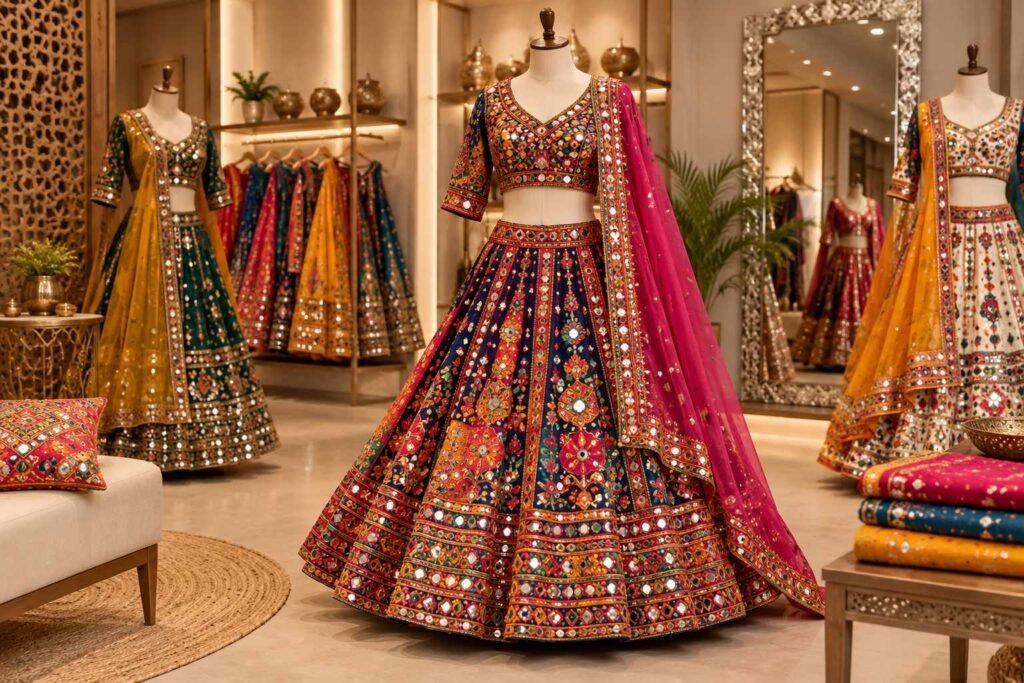
Mirror Work Chaniya Choli Manufacturer & Exporter from India
Scalane Global manufactures and exports Mirror Work Chaniya Choli from India for international B2B buyers looking to develop traditional, festive, Gujarati-inspired, Garba and Navratri collections.
Mirror work is one of the distinctive decorative elements associated with many Indian festive and ethnicwear styles. When incorporated into Chaniya Choli, it can be used across skirts, blouses, dupattas, borders and individual motifs to create visually detailed products for retail and wholesale collections.
Our Mirror Work Chaniya Choli manufacturing capabilities can support:
International retailers
Ethnicwear boutiques
Wholesalers
Distributors
Online fashion brands
Festival retailers
Ethnic fashion businesses
Private-label brands
OEM buyers
Custom apparel buyers
Buyers can develop collections around their preferred mirror-work density, colours, fabrics, embroidery, borders, motifs, sizing, garment construction and packaging requirements.
What Is Mirror Work Chaniya Choli?
Mirror Work Chaniya Choli is a Chaniya Choli style featuring decorative mirror elements incorporated into the garment.
Depending on the design, mirror work may appear on:
Chaniya panels
Choli fronts
Sleeves
Necklines
Waist areas
Dupattas
Borders
Decorative motifs
Mirror work can be combined with embroidery, thread work, appliqué, printed fabrics, decorative borders and other embellishments.
The amount and placement of mirror work can vary significantly between products.
For B2B manufacturing, buyers should therefore specify the desired design, mirror placement, density, colour combination and overall decorative direction rather than relying only on the term “mirror work.”
Mirror Work Chaniya Choli for International B2B Buyers
International buyers may use Mirror Work Chaniya Choli for several commercial applications.
Retail Collections
Retailers can develop dedicated Indian ethnicwear or festive collections featuring mirror-work products.
Boutique Collections
Boutiques can use more curated designs with distinctive colour combinations, embellishment and limited collection depth.
Wholesale Distribution
Wholesalers can develop collections with multiple designs, colours and sizes for distribution to retailers.
Import Businesses
Importers can source finished or customized Mirror Work Chaniya Choli from India for their local markets.
Online Fashion Brands
E-commerce brands can develop mirror-work collections around specific customer segments, festivals or seasonal campaigns.
Festival Retail
Festival-focused businesses can develop collections for Garba, Dandiya and Navratri demand.
Private-Label Brands
Fashion brands can develop mirror-work Chaniya Choli under their own branding and packaging requirements.
Types of Mirror Work Chaniya Choli
Mirror work does not have to look identical across an entire collection.
A manufacturer can develop different product directions based on the buyer’s target market.
Traditional Mirror Work Chaniya Choli
Traditional-inspired designs can incorporate decorative mirror elements with embroidery, borders, motifs and vibrant colour combinations.
These products can be positioned for customers looking for a stronger Indian ethnicwear aesthetic.
Gujarati-Inspired Mirror Work Chaniya Choli
Gujarati-inspired designs can combine mirror work with colourful fabrics, decorative borders, embroidery and traditional-inspired motifs.
These products can be particularly relevant to festive and Garba-oriented collections.
Garba Mirror Work Chaniya Choli
Mirror work can be incorporated into Chaniya Choli specifically developed for Garba collections.
The design can range from relatively simple decorative work to more elaborate festive products.
Navratri Mirror Work Chaniya Choli
Navratri collections can use mirror work as one of the key visual elements across seasonal Chaniya Choli designs.
Buyers can develop multiple colourways and decorative levels to create a broader festival assortment.
Contemporary Mirror Work Chaniya Choli
Contemporary designs can use mirror work more selectively.
For example, mirror work can be concentrated around:
Necklines
Sleeves
Borders
Selected motifs
Choli panels
This can create a more modern interpretation while retaining the decorative character of mirror work.
Mirror Work Chaniya Choli Design Development
A successful B2B collection should begin with a defined product direction.
Buyers can provide:
Design sketches
Reference photographs
Existing garments
Mood boards
Colour references
Mirror-work references
Embroidery references
Border references
Size specifications
The manufacturer can then use these inputs to develop the product specification and sample.
For buyers without finalized designs, the collection can instead be developed around a clearly uk defined commercial brief.
Mirror Work Placement
The location of the mirror work can significantly change the appearance of the finished garment.
Chaniya Mirror Work
Mirror work can be placed across:
Panels
Hemlines
Borders
Motifs
Selected sections
Choli Mirror Work
The Choli can feature mirror work on:
Front panels
Neckline
Sleeves
Back
Borders
Dupatta Mirror Work
Mirror work can also be incorporated into:
Dupatta borders
Decorative motifs
Selected areas
The buyer should specify whether mirror work is required across the complete garment or only selected areas.
Mirror Work Density
Mirror-work products can be developed with different levels of decoration.
Light Mirror Work
A smaller number of decorative mirrors used as accents.
Medium Mirror Work
A balanced combination of mirror work, embroidery and borders.
Heavy Mirror Work
More extensive mirror placement across significant garment areas.
The appropriate density depends on the design, target market, garment construction and intended price positioning.
Scalane Global can manufacture according to the agreed usa product specification rather than applying one standard mirror-work pattern to every collection.
Mirror Work with Embroidery
Mirror work can be combined with embroidery to create additional visual depth.
Possible combinations include:
Mirror + thread embroidery
Mirror + decorative borders
Mirror + motifs
Mirror + appliqué
Mirror + printed fabric
Mirror + contrasting thread
The exact combination should be established during product development and confirmed through sampling.
Mirror Work Chaniya Choli Fabrics
The fabric selection should be considered together with the intended decoration.
Potential fabric options may include:
Cotton
Rayon
Poly-cotton
Georgette
Silk or silk-blend fabrics
Other suitable apparel fabrics
The appropriate fabric depends on:
Garment construction
Design
Mirror-work density
Embroidery
Drape
Weight
Target market
Buyer requirements
The final fabric should be confirmed before bulk production.
Cotton Mirror Work Chaniya Choli
Cotton can be considered for collections where the buyer wants a more breathable and versatile textile direction.
Cotton-based Chaniya Choli can be developed with:
Mirror work
Embroidery
Printed patterns
Decorative borders
Traditional-inspired motifs
The actual construction and decoration should be determined by the product specification.
Rayon Mirror Work Chaniya Choli
Rayon can be considered for designs where the buyer wants a different drape and visual character.
It can be developed with suitable mirror work and embroidery treatments depending on the garment design.
The final fabric selection should be based on the intended product characteristics rather than simply choosing a fabric by name.
Mirror Work Chaniya Choli Colour Development
Colour is an important part of a mirror-work collection.
Buyers can develop:
Vibrant Festival Colours
Bright combinations designed for festive collections.
Traditional-Inspired Colours
Colour combinations intended to reinforce an Indian ethnicwear aesthetic.
Contemporary Colours
More modern combinations for fashion-oriented collections.
Coordinated Colour Families
Several products using a common palette while varying the design and decoration.
Buyers should provide colour references where exact colour matching is commercially important.
Mirror Work Chaniya Choli Size Development
A B2B collection can be developed around the buyer’s required size range.
Possible requirements may include:
XS
S
M
L
XL
XXL
Extended sizes
Children’s sizes
For custom manufacturing, the buyer can provide its own measurement chart.
The manufacturer can then work from the approved measurements during sample development and production.
Mirror Work Chaniya Choli for Kids
Children’s mirror-work Chaniya Choli can be developed as part of family, festival or ethnicwear collections.
The buyer should define:
Age group
Size range
Measurements
Fabric
Decoration
Design
Product components
The decorative treatment should be appropriate to the intended garment and buyer specification.
Mirror Work Chaniya Choli for Extended Sizes
International retailers and online brands may require broader size coverage.
Extended-size development should consider:
Body measurements
Choli measurements
Chaniya measurements
Fit
Pattern proportions
Decoration placement
Simply increasing garment dimensions may not provide the desired fit, so the buyer’s size specification should be established before production.
Custom Mirror Work Chaniya Choli Manufacturing
Custom manufacturing allows buyers to define the product rather than selecting only from standard designs.
Customization can include:
Chaniya design
Choli design
Dupatta
Fabric
Colour
Mirror-work placement
Mirror-work density
Embroidery
Border
Motifs
Size
Fit
Labels
Packaging
Buyers can provide a complete technical specification or begin with references that communicate the intended product direction.
Mirror Work Chaniya Choli Sampling
Sampling is an important stage when the buyer has specific mirror-work requirements.
A sample can help evaluate:
Overall appearance
Fabric
Colour
Mirror placement
Mirror density
Embroidery
Borders
Garment construction
Measurements
Fit
Finishing
For customized products, the approved sample can become a key reference for subsequent bulk production.
Mirror Work Chaniya Choli Pre-Production Approval
Before bulk production, the buyer should confirm the main specifications.
These may include:
Design → Fabric → Colour → Mirror Work → Embroidery → Measurements → Size Range → Branding → Packaging
Clear approval helps reduce ambiguity between the buyer’s expectations and the production specification.
Mirror Work Chaniya Choli Quality Control
Quality control can cover several stages of production.
Fabric Inspection
Check the specified fabric and basic material characteristics.
Colour Check
Compare the production colour with the approved reference where applicable.
Mirror Work Check
Inspect mirror placement, attachment and finishing.
Embroidery Check
Verify embroidery placement and overall execution against the approved specification.
Measurement Check
Check important garment measurements.
Stitching Check
Review seams, construction and finishing.
Overall Appearance
Check the completed garment against the approved sample or specification.
Packaging Check
Verify labels, product identification and agreed packing requirements.
The exact QC procedure should be agreed according to the buyer’s product requirements.
Mirror Work Chaniya Choli for Seasonal Collections
Mirror Work Chaniya Choli can be incorporated into collections designed around:
Navratri
Garba
Dandiya
Indian festivewear
Ethnicwear collections
Cultural events
Seasonal retail campaigns
For international buyers, seasonal planning should account for both manufacturing and international logistics.
Mirror Work Chaniya Choli for Retailers and Boutiques
Retailers can build an assortment using different:
Designs
Colours
Sizes
Decoration levels
Fabrics
Boutiques may choose a more curated range, while larger retailers may require greater SKU depth.
The assortment should reflect the buyer’s customer profile and sales channel.
Mirror Work Chaniya Choli for Wholesalers and Distributors
Wholesalers and distributors may require greater product depth.
A wholesale collection can be organized by:
Design
Colour
Size
Decoration
Product code
This makes it easier to organize inventory and distribute products to multiple retail customers.
Mirror Work Chaniya Choli for Online Fashion Brands
Online fashion businesses can develop mirror-work collections around specific digital merchandising themes.
The buyer should consider:
Product naming
SKU structure
Size charts
Colour variants
Product photography
Product descriptions
Package contents
Individual packaging
The physical product should match the specifications and visual information shown to online customers.
Mirror Work Chaniya Choli for International Importers
Importers can source Mirror Work Chaniya Choli from India for local distribution and retail markets.
Before placing an order, importers should establish:
Product specifications
Quantity
Size ratio
Colour ratio
Packaging
Branding
Destination
Shipping requirements
Applicable import requirements
Import classification and destination-market requirements can vary, so buyers should verify applicable local requirements for their shipment.
Private Label Mirror Work Chaniya Choli
Private-label buyers can develop mirror-work products under their own brand.
Potential requirements include:
Brand labels
Size labels
Hangtags
Product codes
Packaging
Collection names
A private-label collection can use custom designs or approved product concepts developed for the buyer.
OEM Mirror Work Chaniya Choli
OEM manufacturing is appropriate where the buyer provides defined specifications.
These can include:
Design
Fabric
Colour
Measurements
Mirror work
Embroidery
Construction
Labels
Packaging
The approved specification and sample can serve as the production reference.
Request a Mirror Work Chaniya Choli Quote
International buyers can share:
Design references + quantity + fabric + colours + mirror-work requirements + embroidery + sizes + branding + packaging + destination + target season with Scalane Global.
Mirror Work Chaniya Choli Collection Development
For international B2B buyers, developing a Mirror Work Chaniya Choli collection involves more than selecting decorated garments.
The collection should be planned around:
- Target customer
- Selling channel
- Season
- Design direction
- Fabric
- Mirror-work density
- Colour palette
- Size range
- Quantity
- Packaging
- Branding
A well-defined product brief helps translate the buyer’s visual concept into a repeatable manufacturing specification.
Mirror Work Collection Assortment Planning
A buyer can build an assortment using several levels of product variation.
Core Collection
A focused range of designs intended to establish the main collection identity.
Fashion Collection
More design-led products using different colours, silhouettes and decorative combinations.
Festival Collection
Products developed specifically for Navratri, Garba, Dandiya and other festive demand.
Premium Collection
Products with more elaborate decorative development and greater attention to detailing.
The buyer can combine these categories according to the requirements of the target market.
Mirror Work Chaniya Choli SKU Planning
Each product should have a clear product identity.
A SKU structure can differentiate products by:
- Design
- Colour
- Size
- Collection
- Decoration
- Season
For example, a buyer may maintain separate product codes for the same design in different colours and sizes.
This can simplify:
- Purchase orders
- Inventory
- Reordering
- Online listings
- Warehouse management
- Retail distribution
The final SKU system should follow the buyer’s existing inventory structure where applicable.
Mirror Work Chaniya Choli Colour Assortment
A buyer can develop a colour assortment around a defined collection palette.
For example:
Core colours
Products intended to form the foundation of the range.
Festive colours
Brighter combinations suitable for seasonal collections.
Traditional-inspired combinations
Colours selected to reinforce a Gujarati or Indian ethnicwear aesthetic.
Contemporary combinations
Modern colour combinations intended for fashion-oriented buyers.
The objective is not simply to add more colours, but to create commercially useful variation.
Mirror Work Density by Collection
A collection can include different decorative levels.
| Collection Level | Typical Direction |
|---|---|
| Light | Selected mirror accents |
| Medium | Mirror work combined with embroidery/borders |
| Heavy | Extensive decorative mirror-work treatment |
| Premium | Detailed embellishment and specialized design |
These are collection-development categories rather than fixed manufacturing standards.
The buyer should approve the actual mirror-work specification before bulk production.
Mirror Work Specification
For customized manufacturing, buyers should define the mirror-work requirements as clearly as possible.
The specification may include:
- Mirror shape
- Mirror size
- Mirror colour
- Placement
- Density
- Pattern
- Border treatment
- Combination with embroidery
- Coverage area
Reference photographs can be useful, but a final production specification should be established before bulk manufacturing.
Mirror Work Placement Map
For a detailed product, buyers can create a simple placement map.
For example:
Chaniya
- Hem
- Panels
- Motifs
Choli
- Front
- Sleeves
- Neckline
- Back
Dupatta
- Border
- Motifs
- Selected areas
This reduces ambiguity when a design contains multiple decorative components.
Mirror Work and Garment Movement
Chaniya Choli intended for Garba or other active festive use may require consideration of how decoration interacts with garment movement.
The buyer can discuss:
- Mirror placement
- Decoration density
- Garment weight
- Stitching
- Finishing
- Comfort
- Construction
The appropriate construction depends on the specific product and intended use.
Mirror Work Chaniya Choli Design Brief
A useful design brief can include:
Product
Mirror Work Chaniya Choli
Target Market
Country and customer segment
Design
Reference image, sketch or existing garment
Fabric
Preferred material and construction
Colour
Primary and secondary colours
Mirror Work
Shape, size, placement and density
Embroidery
Type, motif and placement
Size
Required size range and measurements
Quantity
Total quantity and quantity by SKU
Branding
Labels, tags and packaging
Delivery
Destination and target selling season
This information allows the manufacturer to understand the product requirement before sample development.
Mirror Work Chaniya Choli Sample Approval
A buyer should evaluate the sample systematically.
Step 1 — Visual Review
Check the overall appearance against the design reference.
Step 2 — Material Review
Confirm fabric, lining and other agreed materials.
Step 3 — Decoration Review
Check mirror work, embroidery, borders and motifs.
Step 4 — Measurement Review
Verify important garment measurements.
Step 5 — Construction Review
Check seams, finishing and garment structure.
Step 6 — Packaging Review
Confirm labels, tags and packaging requirements where applicable.
Once the buyer approves the final specification, the approved version can be used as a production reference.
Mirror Work Chaniya Choli Quality Control Checklist
A B2B buyer can establish a QC checklist covering:
- Fabric
- Colour
- Measurements
- Stitching
- Mirror attachment
- Mirror placement
- Embroidery
- Borders
- Motifs
- Garment finishing
- Labels
- Packaging
For larger or customized orders, the buyer can agree the inspection criteria before production.
Mirror Attachment and Finishing
Because mirror work is a decorative component, buyers should pay attention to:
- Attachment
- Placement
- Finishing
- Consistency
- Loose elements
- Overall appearance
The specific construction method depends on the garment and decorative treatment.
The production sample should demonstrate the agreed finish before bulk manufacturing.
Mirror Work Chaniya Choli Packaging for Export
International shipments require packaging suitable for the product and transportation method.
Potential requirements include:
- Individual garment bags
- Size identification
- Product codes
- Brand labels
- Hangtags
- Carton identification
- Assortment details
Buyers distributing products through multiple retail locations may also benefit from standardized SKU and carton identification.
The final packaging configuration should be agreed before production.
Private Label Mirror Work Chaniya Choli Workflow
A private-label order can follow this structure:
Brand Brief
↓
Design Selection / Development
↓
Fabric & Decoration Specification
↓
Sample Development
↓
Sample Approval
↓
Branding & Packaging Confirmation
↓
Bulk Manufacturing
↓
Quality Control
↓
Packing
↓
Export
The actual workflow can vary according to the complexity of the collection.
OEM vs Private Label vs Custom Mirror Work Chaniya Choli
These terms should not be treated as interchangeable.
Custom Manufacturing
The buyer requires a product developed around specific design or manufacturing requirements.
Private Label
The buyer sells the product under its own brand.
OEM
The buyer provides defined product specifications for manufacturing.
Wholesale
The buyer purchases products in bulk, generally based on available or agreed collections.
A single order can combine more than one model. For example, a buyer may request custom manufacturing and sell the resulting collection under a private label.
Mirror Work Chaniya Choli for Boutiques
Boutiques can build smaller, curated collections around:
- Distinctive designs
- Limited colourways
- Detailed mirror work
- Premium-looking embellishment
- Selected size ranges
A boutique collection does not necessarily need a large number of designs. Product differentiation and collection coherence can be more important.
Mirror Work Chaniya Choli for Retail Chains
Retail businesses operating multiple stores may require:
- Consistent sizing
- SKU identification
- Colour consistency
- Repeatable designs
- Standardized packaging
- Replenishment capability
The product specification should therefore be sufficiently detailed to support repeat production.
Mirror Work Chaniya Choli for Wholesalers
Wholesalers may require greater breadth across:
- Designs
- Colours
- Sizes
- Decorative levels
A wholesale assortment can be organized into product groups so that distributors can select the appropriate range for their retail customers.
Mirror Work Chaniya Choli for Online Fashion Businesses
Online sellers should consider the product from both manufacturing and merchandising perspectives.
Important information can include:
- Exact garment measurements
- Size chart
- Fabric composition
- Product components
- Colour
- Decoration
- Care information
- Package contents
Product photography should accurately represent the actual mirror-work density and design.
Mirror Work Chaniya Choli for Festival Retailers
Festival-focused businesses can develop seasonal ranges around:
- Navratri
- Garba
- Dandiya
- Indian cultural events
- Ethnic fashion campaigns
Because seasonal demand can be concentrated, buyers should plan manufacturing and international logistics before the main selling period.
Seasonal Planning for Mirror Work Chaniya Choli
A useful planning sequence is:
Collection Planning
Determine the range, target market and product direction.
Design Development
Finalize designs, colours and decorative treatments.
Sampling
Develop and review samples.
Approval
Confirm specifications.
Production
Manufacture the approved collection.
Quality Control
Inspect the completed products.
Packaging
Prepare the shipment according to the buyer’s requirements.
Export
Coordinate the shipment and documentation.
The actual production and logistics schedule depends on order complexity, quantity, customization and destination.
Repeat Orders and Seasonal Reorders
A buyer with an established collection may repeat:
- Same design
- Same colour
- New colour
- New size
- Modified decoration
- Related design
Repeat production is easier when the original specification, sample and product code are retained.
For seasonal products, buyers should consider future-season requirements before the existing season finishes.
Mirror Work Chaniya Choli Collection Refresh
A repeat buyer does not necessarily need to replace an entire collection.
A collection can be refreshed through:
- New colours
- New mirror-work patterns
- New borders
- New embroidery
- New silhouettes
- New size offerings
- New coordinated designs
This can provide continuity while introducing new products.
International Buyer Workflow
A typical B2B inquiry can proceed through:
Buyer Requirement
→ Product Discussion
→ Design / Specification
→ Sample Development
→ Buyer Approval
→ Order Confirmation
→ Production
→ Quality Control
→ Packaging
→ Export Documentation
→ Shipment
The exact commercial terms, documentation and logistics depend on the transaction and destination country.
Information Buyers Should Send in Their First Inquiry
To receive a more useful manufacturing discussion, buyers should provide:
- Product reference
- Quantity
- Number of designs
- Fabric preference
- Colour requirements
- Mirror-work requirement
- Embroidery requirement
- Size range
- Branding requirement
- Packaging requirement
- Destination country
- Target season
If a buyer does not have every specification ready, photographs or initial design references can still provide a starting point.
Common Mirror Work Chaniya Choli Buying Mistakes
Choosing a Product Only from a Photograph
A photograph may not communicate fabric, mirror size, density or construction.
Better approach: define the important specifications before production.
Not Defining Mirror-Work Density
“Heavy mirror work” can mean different things to different buyers.
Better approach: use a reference sample or placement specification.
Ignoring Garment Measurements
A visually attractive product can still create problems if the size specification is unclear.
Better approach: approve measurements and size charts.
Mixing Different Decoration Standards
If some products have heavy decoration and others have minimal decoration, the collection should make this intentional.
Better approach: create clear product groups.
Approving Colour Only on a Screen
Digital images can vary by display.
Better approach: use an agreed physical or suitable colour reference where exact colour consistency matters.
Not Defining Package Contents
The buyer should clearly state whether the order includes Chaniya, Choli and Dupatta.
Planning Too Late for a Festival
Seasonal collections need time for development, production and international transportation.
Mirror Work Chaniya Choli Buyer Checklist
Before confirming an order, verify:
Product
- Chaniya design
- Choli design
- Dupatta
- Fabric
- Colour
- Mirror work
- Embroidery
- Borders
Measurements
- Size chart
- Fit
- Garment measurements
- Tolerances
Quantity
- Total quantity
- Quantity by design
- Quantity by colour
- Quantity by size
Branding
- Labels
- Hangtags
- Product codes
- Packaging
Quality
- Approved sample
- Mirror-work specification
- Embroidery specification
- Measurement requirements
Logistics
- Destination
- Packaging
- Carton requirements
- Target season
Frequently Asked Questions
What is Mirror Work Chaniya Choli?
Mirror Work Chaniya Choli is a Chaniya Choli style featuring decorative mirror elements incorporated into areas such as the Chaniya, Choli, Dupatta, borders or motifs.
Does Scalane Global manufacture Mirror Work Chaniya Choli?
Yes. Scalane Global manufactures and exports Mirror Work Chaniya Choli from India for international B2B buyers.
Can buyers customize mirror-work designs?
Yes. Buyers can specify mirror-work placement, density, design direction and combinations with embroidery and borders.
Can mirror work be combined with embroidery?
Yes. Mirror work can be developed together with embroidery, borders, motifs and other decorative treatments.
Can buyers choose the fabric?
Yes. Buyers can specify a preferred fabric, subject to suitability for the intended garment and decoration.
Can Mirror Work Chaniya Choli be made for Navratri?
Yes. Mirror-work designs can be developed specifically for Navratri and related festive collections.
Can Mirror Work Chaniya Choli be used for Garba collections?
Yes. Mirror-work Chaniya Choli can form part of Garba and Dandiya-focused collections.
Can children’s Mirror Work Chaniya Choli be manufactured?
Yes. Children’s products can be developed according to the required age group, measurements, size range and design.
Can extended-size Mirror Work Chaniya Choli be manufactured?
Yes. Extended-size products can be developed around defined measurements and fit requirements.
Can international retailers order Mirror Work Chaniya Choli from India?
Yes. International retailers, boutiques, wholesalers, distributors and importers can source Mirror Work Chaniya Choli from India.
Can Mirror Work Chaniya Choli be manufactured under a private label?
Yes. Private-label production can include brand labels, hangtags, product codes and buyer-specific packaging.
Can buyers order OEM Mirror Work Chaniya Choli?
Yes. OEM production can be developed according to buyer-defined specifications.
What should I include in a Mirror Work Chaniya Choli inquiry?
Ideally provide design references, quantity, fabric, colours, mirror-work requirements, embroidery, sizes, branding, packaging, destination and target season.
Request a Mirror Work Chaniya Choli Quote
Scalane Global manufactures and exports Mirror Work Chaniya Choli from India for international B2B buyers.
Whether the requirement is for a retail collection, boutique range, wholesale assortment, festival collection, online fashion brand, private label or OEM program, buyers can submit their product requirements for discussion.
Share Your Requirement
Design reference + quantity + fabric + colours + mirror work + embroidery + sizes + branding + packaging + destination + target season
This gives the manufacturing team a clear starting point for evaluating the requirement.