
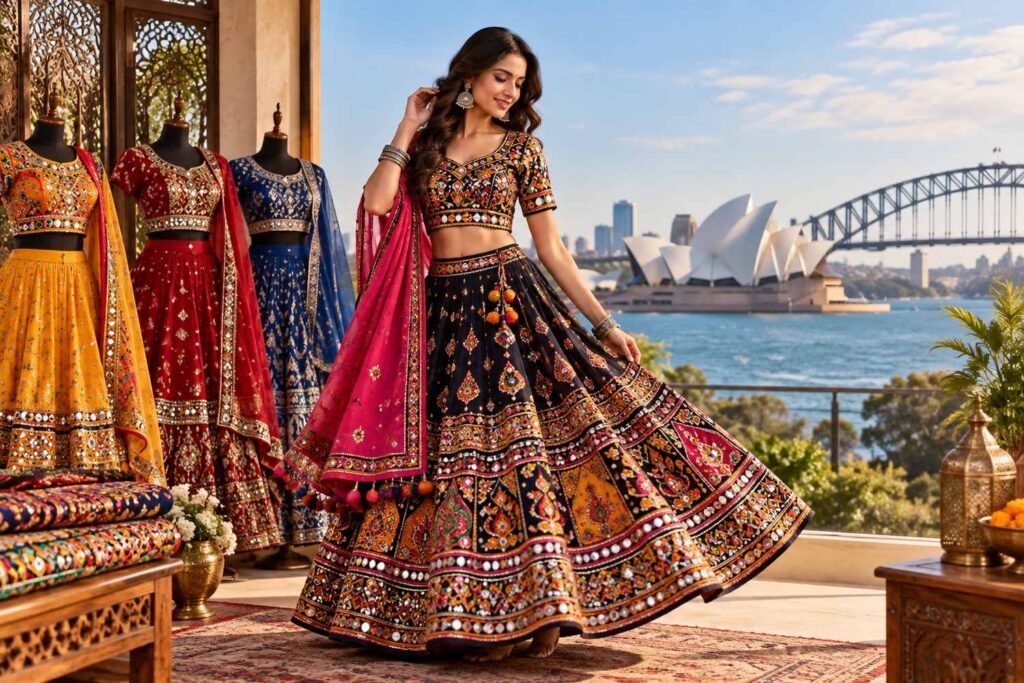
Chaniya Choli Wholesale Australia from India
Scalane Global offers Chaniya Choli wholesale for Australia for retailers, boutiques, wholesalers, distributors, importers, ethnicwear stores, online fashion businesses and other B2B buyers looking to source Indian Chaniya Choli collections from India.
Wholesale collections can be developed around traditional Gujarati Chaniya Choli, Garba styles, Navratri collections, mirror-work designs, embroidered Chaniya Choli, Bandhani combinations, cotton Chaniya Choli, contemporary festivewear, children’s collections and extended-size options.
Australian buyers can select suitable products from existing collections or develop Chaniya Choli around specific requirements for design, fabric, colour, sizing, embellishment, branding and packaging.
The objective is to provide a structured B2B wholesale solution rather than simply supplying individual garments.
Chaniya Choli Wholesale for Australian B2B Buyers
Australian businesses purchasing Chaniya Choli can have very different commercial models.
Scalane Global can develop wholesale collections for:
- Indian ethnicwear retailers
- Fashion retailers
- Boutiques
- Wholesalers
- Distributors
- Importers
- Online fashion businesses
- E-commerce retailers
- Indian clothing stores
- Festival-focused businesses
- Cultural and event-oriented businesses
- Private-label fashion brands
- Businesses serving Indian and South Asian communities
A boutique may want a curated collection with selected designs and colours.
A wholesaler may require greater SKU depth and multiple size options.
An importer may focus on commercial quantities, documentation and shipping.
An online fashion business may require consistent measurements, product coding, individual packaging and repeat availability.
The collection should therefore be developed according to the buyer’s actual sales channel and customer profile.
Why Australian Buyers Source Chaniya Choli from India
India has established textile and apparel manufacturing capabilities, including traditional Indian ethnicwear and contemporary festive clothing.
Sourcing Chaniya Choli from India can give Australian B2B buyers access to:
- Gujarati Chaniya Choli
- Traditional Indian ethnicwear
- Garba collections
- Navratri collections
- Mirror-work designs
- Embroidered Chaniya Choli
- Bandhani combinations
- Cotton Chaniya Choli
- Contemporary designs
- Kids’ Chaniya Choli
- Extended-size collections
- Custom manufacturing
- Private-label manufacturing
- OEM manufacturing
For buyers developing their own collections, direct communication with the manufacturer can also make it easier to discuss fabrics, measurements, colours, europe embellishment, branding and packaging before production.
Australian Chaniya Choli Wholesale Collections
A commercial wholesale collection can be divided into several product groups.
This makes it easier for buyers to balance variety with inventory control.
Traditional Chaniya Choli
Traditional collections can include:
- Gujarati-inspired Chaniya Choli
- Traditional festive designs
- Mirror-work Chaniya Choli
- Embroidered Chaniya Choli
- Bandhani combinations
- Traditional borders
- Decorative motifs
- Coordinated dupattas
These collections can be suitable for Indian ethnicwear stores, boutiques and retailers serving customers looking for traditional Indian clothing.
Garba Chaniya Choli Wholesale Australia
Garba Chaniya Choli can be developed around colourful Indian festivewear and traditional Gujarati-inspired design elements.
Possible product directions include:
- Mirror-work Garba Chaniya Choli
- Embroidered Garba designs
- Traditional Gujarati styles
- Colourful festive collections
- Contemporary Garba designs
- Family collections
- Kids’ Garba Chaniya Choli
Australian businesses can build Garba-focused collections for customers participating in Indian cultural events and festive celebrations.
The Garba product page should remain focused on the product/use-case itself, while this page focuses specifically on Australia + wholesale purchasing.
Navratri Chaniya Choli Wholesale Australia
Navratri collections can form a seasonal component of an Australian wholesale assortment.
Possible collections include:
- Traditional Navratri Chaniya Choli
- Garba designs
- Mirror-work festivewear
- Embroidered collections
- Gujarati-inspired designs
- Colour-based collections
- Kids’ Navratri Chaniya Choli
- Coordinated family collections
For international wholesale buyers, seasonal planning should account for:
- Product selection
- Sampling
- Approval
- Manufacturing
- Quality control
- Packaging
- International shipping
- Import clearance
- Local distribution
Buyers should communicate the intended retail launch period early enough to allow the uae complete supply chain to be planned.
Mirror Work Chaniya Choli Wholesale Australia
Mirror work can be developed in different decorative directions depending on the intended collection.
Buyers can specify:
- Mirror-work density
- Mirror size
- Placement
- Motifs
- Borders
- Embroidery combinations
- Colour combinations
- Chaniya decoration
- Choli decoration
- Dupatta decoration
A collection can include different decoration levels rather than using the same mirror-work density across every SKU.
For example, a buyer may combine relatively simple designs with more heavily decorated festive products.
The actual construction should be reviewed through samples before bulk manufacturing.
Embroidered Chaniya Choli Wholesale Australia
Embroidery provides another option for developing distinctive wholesale collections.
Possible directions include:
- Floral motifs
- Geometric patterns
- Traditional-inspired motifs
- Border embroidery
- Chaniya embroidery
- Choli embroidery
- Dupatta embroidery
- Thread work
- Embroidery combined with mirror work
Australian buyers can provide reference images, sketches, colour references or other design information for custom development.
For larger collections, embroidery can be organized into motif families so several products share a recognizable visual language without being identical.
Bandhani Chaniya Choli Wholesale Australia
Bandhani can be incorporated into Chaniya Choli collections through suitable fabric and design combinations.
Possible product directions include:
- Bandhani Chaniya
- Bandhani dupatta
- Bandhani with mirror work
- Bandhani with embroidery
- Traditional Gujarati combinations
- Contemporary Bandhani-inspired designs
Where a buyer specifically requires authentic Bandhani textile work, that requirement should be clearly stated during product development.
A printed or Bandhani-inspired pattern should not automatically be represented as an authentic Bandhani textile technique.
The final product specification should clearly identify the required fabric and textile process.
Cotton Chaniya Choli Wholesale Australia
Cotton Chaniya Choli can be developed for Australian buyers seeking cotton-based Indian ethnicwear collections.
Product development can consider:
- Cotton fabric construction
- Fabric weight
- Surface appearance
- Colour
- Embroidery
- Mirror work
- Borders
- Chaniya flare
- Choli construction
- Dupatta
Cotton collections can range from relatively simple products to more decorative festive collections.
The appropriate fabric should be selected according to the intended design, construction, decoration and buyer specification.
Contemporary Chaniya Choli for Australian Buyers
Australian fashion businesses may not always require heavily traditional collections.
Contemporary Chaniya Choli can combine Indian design references with updated fashion directions.
Possible approaches include:
- Cleaner silhouettes
- Contemporary colour combinations
- Simplified embellishment
- Modern blouse designs
- Reduced mirror-work density
- Updated embroidery
- Modern borders
- Traditional-contemporary fusion
- Coordinated separates
This can allow retailers and fashion businesses to create Indian ethnicwear collections with a contemporary visual direction.
Kids Chaniya Choli Wholesale Australia
Children’s Chaniya Choli can be developed as a dedicated wholesale category or as part of a larger festive collection.
Possible applications include:
- Navratri
- Garba
- Dandiya
- Indian festivals
- Family collections
- Mother-and-daughter collections
- Children’s ethnicwear
Buyers can specify:
- Age groups
- Size range
- Fabric
- Colours
- Embroidery
- Mirror work
- Bandhani
- Chaniya length
- Choli design
- Dupatta requirements
For children’s products, construction and decorative components should be evaluated according to the intended age group and applicable destination-canada market requirements.
Extended-Size Chaniya Choli Wholesale Australia
Australian buyers may require a broader size assortment depending on their customer base.
Extended-size Chaniya Choli can be developed around:
- Body measurements
- Size grading
- Choli proportions
- Chaniya waist
- Chaniya flare
- Garment length
- Dupatta dimensions
- Fit requirements
For custom production, the buyer should provide a measurement chart.
The approved measurement specification can then become the reference for manufacturing.
Australian Wholesale Collection Planning
A structured collection can be divided into several groups.
Core Collection
Products intended for regular ethnicwear sales.
Festival Collection
Products developed around Navratri, Garba and Indian festive occasions.
Contemporary Collection
Fashion-led designs for customers looking for modern Indian ethnicwear.
Kids Collection
Selected children’s products coordinated with the main collection.
Extended-Size Collection
Selected designs offered in additional sizes.
This structure can provide variety while avoiding the need to manufacture every design in every possible colour and size.
Colour Planning for Australian Wholesale Orders
Colour planning should be considered at the collection level.
A wholesale range can combine:
- Traditional colour combinations
- Bright festive colours
- Jewel-inspired shades
- Pastel combinations
- Contrasting colours
- Tonal combinations
- Contemporary neutrals
- Seasonal colour stories
A useful assortment structure can be:
Core colours + supporting colours + statement colours
This allows the buyer to create visual variety while maintaining a manageable SKU structure.
Final colour specifications should be confirmed through samples or suitable colour references where accuracy is important.
Fabric Selection for Australian Chaniya Choli
Fabric influences:
- Appearance
- Drape
- Comfort
- Garment construction
- Decoration
- Product positioning
Depending on the design, buyers may consider:
- Cotton
- Rayon
- Georgette
- Silk or silk blends
- Poly-cotton
- Other suitable textile constructions
Fabric selection should consider:
- Garment design
- Intended use
- Decoration
- Weight
- Drape
- Durability
- Target customer
- Product positioning
- Destination-market requirements
For international orders, material composition and other product information should be confirmed before final production and labelling.
Chaniya, Choli and Dupatta Coordination
A wholesale collection should be evaluated as a complete product rather than treating each component independently.
Chaniya
Key considerations include:
- Flare
- Length
- Waist construction
- Panels
- Fabric
- Borders
- Embroidery
- Mirror work
- Motifs
Choli
Consider:
- Neckline
- Sleeves
- Length
- Fit
- Embroidery
- Mirror work
- Fastenings where applicable
- Measurement chart
Dupatta
Consider:
- Fabric
- Dimensions
- Border
- Embroidery
- Mirror work
- Colour coordination
- Finishing
The three components should be evaluated together during sampling.
Custom Chaniya Choli Wholesale for Australia
Australian wholesale buyers may require products developed specifically for their collection.
Custom wholesale manufacturing can involve:
- Custom designs
- Custom colours
- Custom fabrics
- Custom embroidery
- Custom mirror-work placement
- Custom borders
- Custom measurements
- Custom size ranges
- Custom labels
- Custom packaging
The buyer can provide:
- Product photographs
- Sketches
- Existing garments
- Mood boards
- Colour references
- Measurement charts
- Embroidery references
The process can then move through sample development, buyer review, revisions where required and final approval before bulk manufacturing.
Private Label Chaniya Choli Wholesale Australia
Australian fashion businesses can develop Chaniya Choli under their own brand through private-label manufacturing.
A private-label program can include:
- Brand labels
- Hangtags
- Product codes
- Custom packaging
- Custom colours
- Custom embroidery
- Custom mirror work
- Size specifications
- Seasonal collections
Private label is useful for businesses that want to sell the collection under their own brand identity.
Branding and packaging requirements should be finalized before production.
OEM Chaniya Choli Wholesale Australia
OEM manufacturing is suitable where the buyer already has defined product specifications.
The buyer may specify:
- Design
- Fabric
- Colour
- Measurements
- Size grading
- Embroidery
- Mirror work
- Borders
- Trims
- Labels
- Packaging
The approved specification becomes the manufacturing reference.
This model can be useful for Australian fashion brands and established retailers that already have their own product-development requirements.
Sampling for Australian Wholesale Buyers
Sampling allows buyers to assess the actual product before committing to bulk production.
A sample can be reviewed for:
- Fabric
- Colour
- Fit
- Measurements
- Chaniya flare
- Choli construction
- Dupatta
- Embroidery
- Mirror work
- Borders
- Finishing
- Overall appearance
For customized products, the sample should be reviewed against the buyer’s original specification.
Once approved, the final product specifications should be documented before bulk production.
Quality Control for Australian Wholesale Orders
Quality control can cover:
Fabric
- Material consistency
- Colour consistency
- Visible defects
- Surface appearance
Stitching
- Seam quality
- Thread finishing
- Construction
- Loose threads
Chaniya
- Waist
- Flare
- Length
- Panels
- Borders
- Decorative elements
Choli
- Measurements
- Neckline
- Sleeves
- Stitching
- Finishing
Dupatta
- Dimensions
- Borders
- Decoration
- Edge finishing
Embroidery and Mirror Work
- Placement
- Stitching
- Decorative consistency
- Loose components
- Missing elements
- Finishing
Final Product
- Size identification
- Product coding
- Overall appearance
- Packaging
- Quantity verification
For custom production, quality should be checked against the approved sample and specification.
Packaging for Australian Wholesale Buyers
Packaging requirements should be established before production.
Depending on the buyer’s requirements, packaging can include:
- Individual garment packing
- Size identification
- Product codes
- Design codes
- Colour identification
- Inner packaging
- Master cartons
- Carton markings
- Buyer-specific labels
- Private-label packaging
A structured packaging system can make receiving and warehouse organization easier.
For example:
Product Code → Colour → Size → Quantity → Carton Number
This can be particularly useful for wholesale buyers handling multiple designs and variants.
Australian Buyer Segments
Retailers
Retailers can develop a balanced range including:
- Traditional Chaniya Choli
- Gujarati styles
- Garba collections
- Navratri collections
- Mirror-work products
- Embroidered products
- Kids’ collections
- Extended-size options
Boutiques
Boutiques may focus on:
- Curated collections
- Distinctive designs
- Designer-oriented products
- Limited colour stories
- Custom collections
- Private label
Wholesalers
Wholesalers may require:
- Multiple designs
- Multiple colours
- Multiple sizes
- Greater SKU depth
- Repeat availability
- Organized packaging
Distributors
Distributors supplying several retailers may prioritize:
- Consistent specifications
- Assortment depth
- Product coding
- Repeat production
- Standardized packaging
Online Fashion Businesses
Online businesses may require:
- Consistent measurements
- Size charts
- Product codes
- Variant organization
- Individual packaging
- Repeatable specifications
Importers
Importers may focus on:
- Product assortment
- Commercial quantities
- Shipping
- Documentation
- Import requirements
- Landed cost
- Replenishment
Seasonal Planning for Australian Buyers
Navratri and Garba collections should be planned around the intended selling period.
An international wholesale order may involve:
Market planning → Design selection → Sampling → Approval → Purchase order → Production → Quality control → Packaging → Export → International shipping → Import clearance → Local distribution → Retail launch
The actual production and transportation schedule depends on:
- Number of designs
- Order quantity
- Customization
- Fabric availability
- Embroidery
- Mirror work
- Branding
- Packaging
- Shipping method
- Destination
Australian buyers should communicate their intended retail launch period when requesting a quotation.
Building a Repeat Wholesale Program
Repeat wholesale orders can combine approved existing products with new collection development.
A buyer can retain:
Core Products
Existing designs that remain relevant.
New Colours
New colourways using established designs.
New Decoration
Updated embroidery, mirror work or borders.
Seasonal Products
New Navratri and Garba designs.
New Silhouettes
Selected contemporary styles.
This approach can help maintain collection freshness without rebuilding the entire assortment each season.
What Australian Buyers Should Include in a Wholesale Inquiry
A detailed inquiry can include:
Company Information
- Company name
- Buyer type
- Australian location
- Website
- Sales channel
Product Requirements
- Chaniya Choli category
- Number of designs
- Approximate quantity
- Fabric preference
- Colours
- Embroidery
- Mirror work
- Bandhani
- Size range
- Kids’ requirements
- Extended-size requirements
Commercial Requirements
- Ready collection or custom
- Standard wholesale or private label
- OEM requirement
- Branding
- Packaging
- Intended delivery period
- Destination
- Preferred shipping arrangement
Reference Material
- Product photographs
- Sketches
- Mood boards
- Measurement charts
- Colour references
- Branding guidelines
The more complete the buyer brief, the easier it is to evaluate the appropriate product and manufacturing approach.
Start Your Chaniya Choli Wholesale Inquiry for Australia
Australian retailers, boutiques, wholesalers, distributors, importers and online fashion businesses can share their Chaniya Choli requirements with Scalane Global.
Whether the requirement is a traditional Gujarati collection, Garba and Navratri assortment, mirror-work range, embroidered collection, Bandhani combination, cotton Chaniya Choli, kids’ collection, extended-size range, private label or OEM program, the product specifications can be developed around the buyer’s requirements.
Share your destination, designs, quantity, fabrics, colours, sizes, branding and packaging requirements to begin a Chaniya Choli wholesale inquiry for Australia.
Australia-Specific Wholesale Planning
Australian buyers sourcing Chaniya Choli from India should consider more than product design and wholesale quantity.
A commercially successful import program should account for:
- Product specifications
- Fabric composition
- Size requirements
- Quality control
- Packaging
- Labelling
- Import classification
- Customs
- GST
- Freight
- Clearance
- Local distribution
- Seasonal demand
The exact requirements depend on the product, destination, transaction structure and buyer’s sales channel.
For this reason, Australian buyers should communicate their intended destination and product requirements before production begins.
Australia as a Chaniya Choli Wholesale Market
Australian B2B buyers can include:
- Indian ethnicwear retailers
- Fashion boutiques
- Wholesalers
- Distributors
- Importers
- Online fashion businesses
- E-commerce retailers
- Indian clothing stores
- Festival-focused businesses
- Cultural-event businesses
- Private-label brands
- Fashion businesses serving Indian and South Asian communities
The collection required by each buyer can be different.
A boutique may prefer a small curated range.
A wholesaler may require greater SKU depth.
An importer may need commercial quantities and organized export documentation.
An online retailer may require consistent measurements, product coding and individual packaging.
The wholesale program should therefore be developed around the buyer’s business model.
Australia Import and Customs Planning
Australian importers should establish the customs requirements before placing a commercial order.
The Australian Border Force states that imported goods require classification under the Customs Tariff Act 1995, and importers are responsible for correctly assessing tariff classification. ABF also provides a tariff advice service and recommends licensed customs brokers where classification is uncertain.
For Chaniya Choli, buyers should confirm the applicable tariff classification based on the actual garment construction, textile composition and other relevant characteristics.
Do not assume that every Chaniya Choli shipment has the same customs classification or duty treatment.
The importer should verify:
- Tariff classification
- Customs value
- Country of origin
- Applicable duty
- Import GST
- Import processing charges
- Customs clearance requirements
- Documentation
- Any other destination charges
Australia’s current tariff schedule contains textile and clothing classifications, but the applicable rate depends on the actual classification and circumstances of the imported goods.
Australian Import Declarations
Australian Border Force states that an Import Declaration generally applies when an imported consignment has a combined value over AUD 1,000 and is being cleared into home consumption. Relevant duties, taxes and charges may apply, and ABF encourages first-time or infrequent importers to use a licensed customs broker.
This threshold should not be treated as a universal statement that all shipments below AUD 1,000 are free from every requirement.
The applicable declaration, duty, tax and clearance treatment depends on the shipment and relevant Australian rules.
For commercial wholesale orders, the buyer should confirm the appropriate import process before shipment.
GST on Chaniya Choli Imports into Australia
Australian Border Force states that GST is payable on taxable imports unless an exemption applies.
The current GST rate for taxable importations is 10%. ABF explains that the value of a taxable importation generally incorporates the customs value, applicable customs duty and relevant international transport and insurance amounts.
Australian buyers should therefore include applicable GST and import-related charges when calculating landed cost.
A simplified commercial calculation can consider:
Product value + applicable duty + international transport and insurance where relevant + applicable import charges + GST + customs brokerage + local delivery
The exact calculation should be confirmed for the specific shipment.
Landed Cost for Australian Wholesale Buyers
A factory or export quotation should not automatically be treated as the final landed cost in Australia.
A buyer can evaluate:
Product Cost
The agreed wholesale or manufacturing price.
Export Costs
Depending on the transaction:
- Export handling
- Documentation
- Packaging
- Origin-side logistics
International Freight
Depending on the chosen transportation method.
Insurance
Where applicable and depending on the commercial terms.
Customs and Import Charges
Potentially including:
- Customs duty
- Import processing charges
- Customs brokerage
- Clearance charges
GST
Applicable GST should be incorporated into the buyer’s landed-cost calculation.
Local Delivery
Costs from the Australian arrival point to the buyer’s warehouse, store or fulfilment location.
Australian Government business guidance also identifies transport, insurance, storage, customs brokerage, clearance and other charges as potential components of importing costs.
Textile and Clothing Classification
Chaniya Choli is a textile clothing product, but the exact Australian tariff classification depends on the product’s actual characteristics.
Relevant factors can include:
- Garment type
- Textile material
- Woven or knitted construction
- Fibre composition
- Garment component
- Product construction
- Applicable tariff rules
Australian Border Force publishes the current tariff classification system and states that importers have a legal responsibility to correctly assess classification.
For commercial shipments, buyers should confirm the classification with their customs broker or obtain appropriate tariff advice where necessary.
Fibre Composition and Product Information
Australian buyers should establish accurate product information before final labelling.
For each Chaniya Choli, the buyer may need to know the actual composition of:
- Chaniya
- Choli
- Dupatta
- Relevant textile components
For example, a product should not be described as a particular fibre composition unless the actual product supports that description.
Accurate product information is important for both compliance and customer communication.
The ACCC has previously taken enforcement action involving inaccurate textile fibre-content claims, demonstrating the importance of accurate garment information.
Care Labelling for Australian Chaniya Choli
Australia has a mandatory care-labelling information standard for clothing and textile products.
The ACCC’s 2023–24 annual report states that the Consumer Goods (Care Labelling) Information Standard 2023 was made in August 2023 and requires clothing and textile products to have adequate care-labelling instructions attached. From March 2024, suppliers can provide care instructions using either international care symbols or instructions written in English.
For Chaniya Choli, buyers should therefore establish the appropriate care instructions before final production and labelling.
Care information can be influenced by:
- Fabric composition
- Embroidery
- Mirror work
- Decorative components
- Dyeing
- Printing
- Garment construction
The final care instructions should reflect the actual product rather than using generic instructions for every garment.
Country-of-Origin Information
Australian businesses need to ensure that origin claims are accurate and not misleading.
Australian Government business guidance states that country-of-origin claims must be truthful and accurate.
For Chaniya Choli manufactured in India, the buyer should ensure that any origin representation accurately reflects the applicable origin rules.
This can be relevant to:
- Product labels
- Packaging
- Product descriptions
- Website listings
- Marketing materials
- Commercial documentation
Do not make an Australian-origin claim merely because the product is sold by an Australian business.
Product Safety Responsibilities in Australia
Australian businesses selling consumer products have product-safety responsibilities.
The ACCC states that products sold to consumers must be safe and that businesses must comply with applicable mandatory standards and product bans.
For Chaniya Choli, product-development and quality-control processes should consider:
- Garment construction
- Stitching
- Decorative components
- Embellishments
- Sharp or poorly finished components
- Small components where relevant
- Children’s products
- Product instructions and warnings where applicable
The exact requirements depend on the product.
For specialised compliance questions, Australian buyers should obtain appropriate professional or regulatory advice.
Children’s Chaniya Choli for Australia
Children’s Chaniya Choli requires additional attention because the intended age group can affect applicable safety requirements.
Buyers should communicate:
- Intended age group
- Size range
- Garment construction
- Decorative components
- Mirror work
- Embroidery
- Cords or ties where relevant
- Fabric composition
- Care requirements
- Packaging
- Destination-market requirements
Where a product falls under a specific Australian mandatory standard, the buyer should verify the applicable requirements before production.
The ACCC maintains current information on mandatory standards and product safety requirements.
Mirror Work and Decorative Safety
Mirror-work Chaniya Choli requires careful finishing.
Quality control can inspect:
- Mirror attachment
- Stitching
- Loose decorative elements
- Sharp edges
- Decorative consistency
- Border finishing
- Embroidery
- Overall garment construction
For children’s products, decorative components should receive additional attention based on the intended age group and applicable safety requirements.
This should be considered during sample development rather than after bulk production.
Packaging for Australian Wholesale Orders
Australian buyers can establish packaging requirements before production.
Possible packaging components include:
- Individual garment packaging
- Product labels
- Size labels
- SKU codes
- Colour identification
- Hangtags
- Inner cartons
- Master cartons
- Carton markings
- Private-label packaging
For wholesale distribution, cartons can be organized according to:
SKU → Colour → Size → Quantity → Carton Number
This can make warehouse receiving and stock allocation easier.
Australian Packaging Requirements
Packaging requirements can differ according to the buyer’s own retail policies and applicable Australian rules.
Buyers may specify:
- Packaging material
- Individual garment packaging
- Recyclable packaging preferences
- Carton dimensions
- Labels
- Barcodes
- Hangtags
- Private-label requirements
Retailers and online fashion businesses may also have their own packaging standards.
These requirements should be finalized before production.
Shipping Chaniya Choli from India to Australia
The transportation method depends on:
- Quantity
- Carton volume
- Order value
- Required delivery period
- Destination
- Buyer preference
Courier
Can be useful for:
- Samples
- Small shipments
- Product-development orders
- Urgent documents
Air Freight
Can be considered for:
- Time-sensitive stock
- Seasonal replenishment
- Smaller commercial shipments
- Higher-value products
Sea Freight
Can be considered for:
- Larger wholesale orders
- Higher-volume shipments
- Planned inventory
- Cost-sensitive transportation
The final method should be selected after the buyer provides the shipment quantity, dimensions and destination.
Incoterms for Australia Wholesale Orders
The quotation should clearly identify the agreed Incoterm.
Possible commercial terms can include:
- EXW
- FCA
- FOB
- CFR
- CIF
- DAP
- Other suitable Incoterms
The selected term determines the allocation of responsibilities between buyer and seller.
The buyer should understand who is responsible for:
- Export clearance
- International freight
- Insurance
- Import clearance
- Customs duty
- GST and other taxes
- Local delivery
An unclear Incoterm can make landed-cost calculations difficult.
Australia Seasonal Planning
Australian buyers should plan Navratri and Garba collections around the intended selling period.
The international supply chain can include:
Market planning
↓
Design selection
↓
Sample development
↓
Approval
↓
Purchase order
↓
Production
↓
Quality control
↓
Packaging
↓
Export documentation
↓
International transportation
↓
Australian customs clearance
↓
Local distribution
↓
Retail launch
The exact timeline depends on order complexity, quantity, customization and transportation method.
For seasonal wholesale programs, buyers should communicate their target launch period during the quotation stage.
Australian Wholesale Inventory Strategy
A structured inventory approach can separate the collection into:
Core SKUs
Products that remain relevant across multiple selling periods.
Seasonal SKUs
Navratri and Garba products intended for seasonal demand.
Test SKUs
Selected products introduced in controlled quantities where commercially appropriate.
Replenishment SKUs
Products that can be reordered when demand supports additional production.
This structure can help buyers manage SKU complexity.
Repeat Wholesale Orders for Australia
Repeat orders can be simplified when the buyer maintains approved product specifications.
Important records can include:
- Product code
- Design reference
- Fabric
- Colour
- Measurements
- Size range
- Embroidery
- Mirror-work specifications
- Packaging
- Approved sample
New colours or new decorative variations can then be developed separately from established products.
This can support a more organized long-term wholesale program.
Private Label Chaniya Choli for Australian Brands
Australian fashion businesses can develop their own branded Chaniya Choli collections.
Private-label requirements may include:
- Brand labels
- Hangtags
- Product codes
- Custom packaging
- Custom colours
- Custom embroidery
- Mirror-work designs
- Size specifications
- Seasonal collections
The buyer’s brand requirements should be documented before production.
Private label is distinct from standard wholesale because the product is developed for sale under the buyer’s own brand identity.
OEM Chaniya Choli for Australia
OEM manufacturing is suitable where the Australian buyer provides defined product specifications.
The buyer can specify:
- Design
- Fabric
- Colour
- Measurements
- Size grading
- Embroidery
- Mirror work
- Borders
- Trims
- Labels
- Packaging
The approved specification becomes the manufacturing reference.
This can be useful for established fashion brands and retailers with their own product-development process.
Custom Chaniya Choli Manufacturing for Australia
Custom manufacturing allows Australian buyers to develop products specifically for their market.
Custom elements can include:
- Silhouette
- Fabric
- Colour
- Embroidery
- Mirror work
- Borders
- Motifs
- Chaniya flare
- Choli design
- Dupatta
- Sizing
- Labels
- Packaging
The buyer can provide:
- Photographs
- Sketches
- Existing garments
- Mood boards
- Colour references
- Measurement charts
- Embroidery concepts
Samples should be reviewed and approved before bulk production.
Quality Control Before Export
A pre-shipment quality-control process can cover:
Product
- Design conformity
- Fabric
- Colour
- Measurements
- Construction
Decoration
- Embroidery
- Mirror work
- Borders
- Motifs
- Loose threads
- Decorative consistency
Quantity
- SKU quantities
- Size quantities
- Colour quantities
Packaging
- Labels
- Product codes
- Individual packaging
- Cartons
- Carton markings
For custom products, the approved sample should remain the principal reference.
Australian Buyer Checklist
Before requesting a wholesale quotation, buyers should prepare:
Destination
- Australian state/city
- Delivery address
- Warehouse or retail location
Buyer Type
- Retailer
- Boutique
- Wholesaler
- Distributor
- Importer
- Online business
- Fashion brand
Product
- Chaniya Choli type
- Number of designs
- Quantity
- Fabric
- Colours
- Embroidery
- Mirror work
- Bandhani
- Size range
- Kids’ requirements
- Extended-size requirements
Branding
- Standard wholesale
- Private label
- OEM
- Custom
Packaging
- Individual packaging
- Labels
- Hangtags
- Barcodes
- Carton requirements
Import
- Tariff classification
- Importer details
- Customs broker where applicable
- Required documentation
- GST treatment
- Destination charges
Logistics
- Required delivery period
- Preferred shipping method
- Incoterm
- Final destination
Questions Australian Buyers Should Ask Before Ordering
- Can you manufacture Chaniya Choli according to our specifications?
- Can you develop custom colours?
- Can you develop custom embroidery?
- Can you develop mirror-work collections?
- Can you manufacture Bandhani Chaniya Choli?
- Can you develop kids’ collections?
- Can you develop extended sizes?
- Can you provide private-label manufacturing?
- Can you provide OEM manufacturing?
- Can you provide samples?
- How is quality controlled?
- How are garments packed for export?
- Can packaging be customized?
- What information is required for a shipping quotation?
- Which Incoterms can be offered?
- Can repeat orders be produced using the approved specification?
- What product information should be finalized before Australian import?
Common Mistakes Australian Wholesale Buyers Should Avoid
1. Treating Australia as One Generic Customer
Customer preferences can differ by retailer, location, sales channel and target community.
2. Ordering Too Many SKUs
Too many combinations of designs, colours and sizes can increase inventory complexity.
3. Not Confirming Fibre Composition
Product information should accurately reflect the actual garment.
4. Ignoring Care Labelling
Australian care-labelling requirements should be considered before final production.
5. Assuming a Universal Customs Duty
The applicable tariff treatment depends on classification and relevant Australian customs rules.
6. Calculating Only Product Cost
Freight, customs, GST, brokerage and local charges can affect landed cost.
7. Not Confirming the Incoterm
The buyer should understand which costs and responsibilities are included in the quotation.
8. Approving Production Without Samples
Samples provide an opportunity to confirm design, fit, fabric and decoration.
9. Leaving Packaging Until Shipment
Packaging, labels and carton requirements should be finalized before production.
10. Planning Navratri Stock Too Late
International production and transportation require advance planning.
Frequently Asked Questions
What is Chaniya Choli Wholesale Australia?
Chaniya Choli Wholesale Australia refers to bulk B2B sourcing of Chaniya Choli collections for Australian retailers, boutiques, wholesalers, distributors, importers and online fashion businesses.
Can Australian buyers source Chaniya Choli from India?
Yes. Australian businesses can source Chaniya Choli from Indian manufacturers and exporters for wholesale, custom, private-label and OEM programs.
What types of Chaniya Choli are available for Australia wholesale?
Collections can include Gujarati, traditional, Garba, Navratri, mirror-work, embroidered, Bandhani, cotton, contemporary, kids and extended-size Chaniya Choli.
Can Australian buyers order custom Chaniya Choli?
Yes. Custom manufacturing can cover design, fabric, colours, measurements, embroidery, mirror work, borders, sizing, labels and packaging.
Can Australian brands order private-label Chaniya Choli?
Yes. Private-label collections can be developed around the buyer’s brand identity, product specifications, labels and packaging.
Can Australian buyers order OEM Chaniya Choli?
Yes. OEM production can be developed according to buyer-defined specifications for design, fabric, colour, measurements, decoration and packaging.
Can Australian buyers order kids’ Chaniya Choli?
Yes. Children’s collections can be developed for Navratri, Garba, festivals and Indian ethnicwear markets. Applicable Australian safety and product requirements should be checked for the intended products.
Can Australian buyers order extended-size Chaniya Choli?
Yes. Extended-size collections can be developed around an agreed measurement chart and grading specification.
Can Australian buyers order mirror-work Chaniya Choli?
Yes. Mirror-work collections can be developed with different mirror sizes, placement, density, motifs, borders and embroidery combinations.
Can Australian buyers order Bandhani Chaniya Choli?
Yes. Bandhani and Bandhani-inspired collections can be developed according to the buyer’s required textile process and design specification.
Is care labelling required for Chaniya Choli sold in Australia?
Australia has a mandatory care-labelling information standard for clothing and textile products. The current standard requires adequate care instructions, with suppliers able to use international care symbols or instructions written in English.
What is the GST rate on taxable imports into Australia?
Australian Border Force currently states that GST on taxable importations is 10%, subject to applicable rules and exemptions.
Do Australian imports of Chaniya Choli have one fixed customs duty rate?
No. The applicable customs treatment depends on the correct tariff classification and other relevant factors. Australian Border Force requires importers to correctly classify imported goods.
Is an Import Declaration required for Australian wholesale shipments?
For consignments over AUD 1,000 being cleared into home consumption, ABF states that an Import Declaration is generally required. The specific declaration and treatment should be confirmed for the actual shipment.
Can Chaniya Choli be shipped from India to Australia by air?
Yes. Air freight can be considered for samples, smaller commercial shipments and time-sensitive inventory.
Can large Chaniya Choli wholesale orders be shipped by sea?
Yes. Sea freight can be considered for larger commercial orders where shipment volume and delivery planning make it appropriate.
How early should Australian buyers plan Navratri Chaniya Choli?
Buyers should allow sufficient time for design selection, sampling, approval, manufacturing, quality control, packaging, international transportation and Australian import clearance.
Can successful designs be reordered?
Yes. Repeat production can be planned around approved specifications, subject to materials, quantity and manufacturing requirements.
Chaniya Choli Wholesale Australia from India
Australian buyers can develop Chaniya Choli wholesale collections around their own retail, distribution or online business requirements.
Scalane Global can support B2B requirements involving:
- Traditional Gujarati Chaniya Choli
- Garba Chaniya Choli
- Navratri collections
- Mirror-work Chaniya Choli
- Embroidered Chaniya Choli
- Bandhani collections
- Cotton Chaniya Choli
- Contemporary Chaniya Choli
- Kids’ Chaniya Choli
- Extended-size collections
- Custom manufacturing
- Private-label manufacturing
- OEM manufacturing
- Sampling
- Quality control
- Export packaging
- International order coordination
The appropriate production model depends on whether the buyer requires a ready wholesale collection, custom development, private label or OEM manufacturing.
Request a Chaniya Choli Wholesale Quote for Australia
Australian retailers, boutiques, wholesalers, distributors, importers and online fashion businesses can share their requirements for Chaniya Choli wholesale from India.
To evaluate the requirement, provide:
- Australian destination
- Product category
- Approximate quantity
- Number of designs
- Fabric preference
- Colour requirements
- Size range
- Embroidery or mirror-work requirements
- Kids or extended-size requirements
- Branding requirements
- Packaging requirements
- Required delivery period
- Preferred shipping method
Request a Chaniya Choli Wholesale Australia quotation and share your product requirements with Scalane Global.